

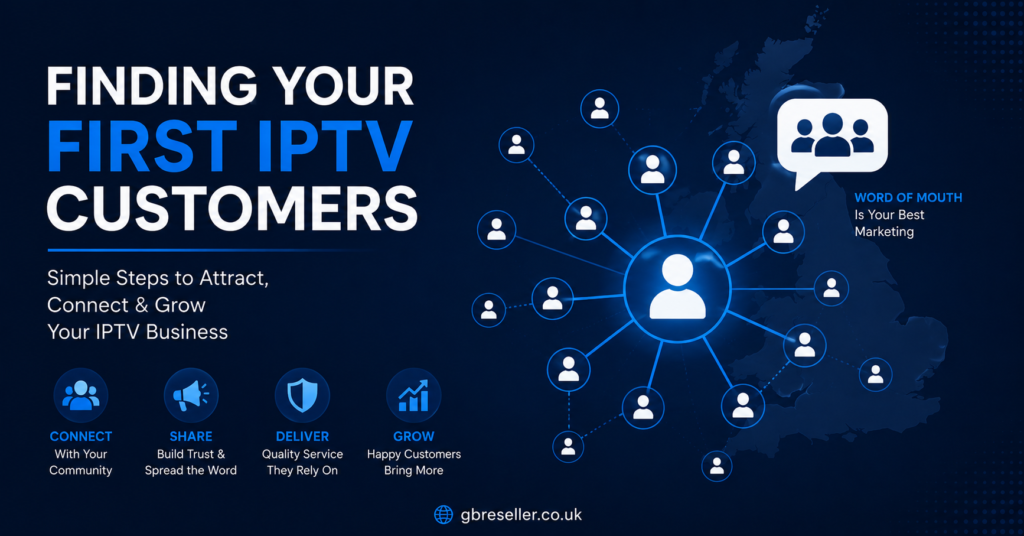
Working out how to get your first 50 IPTV clients in the UK comes down to three things happening in order: picking a panel setup you can actually support, finding a small number of people who trust you personally, and turning each of them into a source of referrals before you spend a penny on advertising. Most new resellers try to skip straight to advertising and end up with customers they cannot service properly. The first 50 should be earned slowly, through people you can reach directly, not bought in bulk.
Why the First 50 Subscribers Are Different From the Next 500
The early stage of any UK IPTV reseller business runs on trust rather than volume. A stranger has no reason to hand a monthly payment to someone with no track record, so your first customers are almost always people who already know you, or people who found you through someone who does. This is why the first 50 tend to come from a small radius, family, friends, local contacts, or a niche online community, rather than from paid adverts.
There is also a practical reason to keep the first batch small on purpose. Every new subscriber needs a working line, a device that is set up correctly, and someone to message when a channel drops out. Taking on 50 accounts before you understand your own panel well enough to troubleshoot them is how new resellers lose customers in the first month rather than keep them.
Pro tip: Before advertising anything, activate two or three test lines on your own devices first. You cannot answer a support question about buffering or app setup if you have never watched a stream through your own panel.
Choosing a Panel and Credits Setup Before You Sell Anything
The panel decision shapes everything that follows, so it is worth getting right before the first sale rather than after the tenth complaint. Look at three things specifically: how credits are purchased and whether they expire, how the reseller dashboard is laid out, and what support actually looks like when something goes wrong outside office hours.
A reseller dashboard walkthrough is worth reading in full before you buy your first credits pack, since the dashboard is where you will spend most of your operational time, creating lines, extending subscriptions, and checking connection status. If the dashboard is confusing to you as the reseller, it will be far harder to support a paying customer through it.
| Question to Ask | Why It Matters |
|---|---|
| Do credits expire? | Unused credits sitting idle waste money if you buy more than you need early on |
| What happens during peak hours? | Football nights and PPV events are when weak infrastructure shows itself first |
| How fast is support outside office hours? | Your customers will message you at 9pm, and you will need answers from your provider |
Providers such as britishseller.co.uk illustrate the kind of dashboard and credits model common among UK-facing panels, though the same evaluation questions apply whichever provider you choose, and no provider should be assumed reliable purely because the website looks professional.
Where UK Resellers Actually Find Their First Customers
Most successful early growth comes from three overlapping sources rather than one clever tactic. Family and friends are the obvious starting point, but treat them as real customers with real expectations rather than favours, since a poorly supported free trial for a relative can do more reputational damage than a stranger’s complaint.
Local community groups, both online and offline, tend to produce steady early interest because recommendations there carry weight. A single satisfied customer mentioning their setup in a community group or to a neighbour is often worth more than a paid advert to strangers who have no reason to trust a new seller.
Paid advertising is not off the table, but it works better once you already have a handful of happy customers who can vouch for the service, since new resellers advertising to cold audiences with zero track record often attract the most price-sensitive, least loyal customers first.
Setting a Starter Price That Doesn’t Sabotage Your Margins
New resellers often underprice their first subscriptions to win customers quickly, then struggle to raise prices later without losing them. It is worth deciding your pricing structure before your first sale rather than reacting customer by customer.
| Pricing Approach | Best For | Limitation |
|---|---|---|
| Flat starter price for everyone | Simplicity while you learn the panel | No flexibility for multi-device or family plans |
| Tiered pricing by device count | Customers with several TVs or boxes | Requires clearer terms and slightly more admin |
| Introductory discount, standard renewal | Attracting the first cautious customers | Renewal price shock if not explained clearly upfront |
Whichever structure you choose, be transparent about what happens at renewal from day one. A customer who discovers a price increase without warning is far more likely to churn than one who understood the terms from the start, and unclear pricing is one of the fastest ways to burn through the trust that got you the first 50 sign-ups.
Turning One Customer Into Three Without Spending Anything
Referrals do more work than any advert for a business this size, but they rarely happen automatically. A customer needs a reason and a moment to think of you, not just a good experience they quietly enjoy alone.
Simple habits build this naturally: checking in after the first week to catch setup issues before they become complaints, being upfront when something is genuinely wrong with the service rather than deflecting, and mentioning directly that you take on a limited number of new customers so referrals feel like access rather than a sales pitch.
Pro tip: Ask satisfied customers a specific question, such as whether anyone in their household or friend group has been complaining about their current provider, rather than a general “know anyone who wants IPTV?” A specific prompt gets a specific answer.
Handling Support and Churn Expectations Early
Every reseller loses some subscribers in the first few months, and treating this as normal rather than a personal failure keeps decision-making level-headed. What matters more is understanding why a customer left, a genuine outage, a device compatibility issue, a payment problem, or simply moving on, so the same mistake is not repeated with the next 50.
A guide to diagnosing server issues is useful to have read in advance, since being able to quickly tell a customer whether an issue is on their end, on the panel’s end, or a wider outage builds far more confidence than a vague “let me check and get back to you.”
Growing Beyond 50: When Sub-Reseller Structures Start to Make Sense
Once the first 50 subscribers are stable and manageable, some UK IPTV resellers consider bringing on a sub-reseller to help with growth, effectively letting someone else sell under their account for a share of the margin. This is not necessary for everyone, and it introduces new responsibilities around support and account ownership that are worth understanding before taking that step.
The process for setting up sub-reseller accounts covers the permissions and structure involved, and it is worth reading even if you are not ready for it yet, since it clarifies what growth beyond a solo operation actually looks like in practice.

Common Mistakes New Resellers Make Chasing the First 50
A few patterns show up repeatedly among new resellers, and most of them come from moving faster than the support structure can handle. Buying a large credits pack before testing the panel personally is one of the most common, since unused or wasted credits are an expensive way to learn a dashboard.
Advertising broadly before having a single reference customer is another. Without anyone to vouch for the service, cold advertising tends to attract the most demanding, least loyal buyers, which is a difficult way to start. A full breakdown of recurring reseller mistakes is worth reading alongside this guide, since several of the same patterns tend to resurface as resellers scale past their first 50 clients too.
Subscriber and Reseller Perspectives on the First 50
From a subscriber’s point of view, what matters is clarity: a working line, a clear price, honest answers when something goes wrong, and a straightforward way to get support. Subscribers rarely churn purely because of an occasional technical issue; they churn when they feel ignored or misled about what they were paying for.
From the reseller’s side, the priority is sustainable operations over speed. Fifty well-supported, paying subscribers who stay for months and refer others are worth considerably more than fifty short-lived sign-ups who churn within weeks and leave negative word of mouth behind them.
Frequently Asked Questions
How long does it typically take to reach 50 IPTV clients as a new UK reseller?
There is no fixed timeline, since it depends heavily on your existing network and how much time you can give to support and follow-up. Some resellers reach this stage within a couple of months through personal contacts and referrals, while others take longer if they are building from a smaller starting network.
Should I buy a large credits pack before I have any customers?
Most new UK IPTV Panel resellers are better served by a smaller starter pack first, since it limits financial risk while you learn the dashboard, test devices, and understand support response times before committing to a larger volume.
Is it worth advertising before I have any customers at all?
Advertising tends to work better once you have at least a few satisfied customers who can be referenced or who provide word of mouth, since cold advertising with no track record often attracts the least loyal buyers.
What is the biggest reason new IPTV resellers lose early customers?
Poor communication is more common than technical failure. Customers who are told honestly what is happening during an issue tend to stay far more often than customers left waiting without an update.
Do I need a sub-reseller to reach 50 clients?
No, a sub-reseller structure is generally only relevant once you are looking to grow beyond what you can personally support, not for reaching your first 50 subscribers.
How do I know if my provider’s support is good enough before I commit?
Test it before you buy in volume. Message support with a genuine setup question and see how quickly and clearly they respond, since this is the same experience your future customers will have.