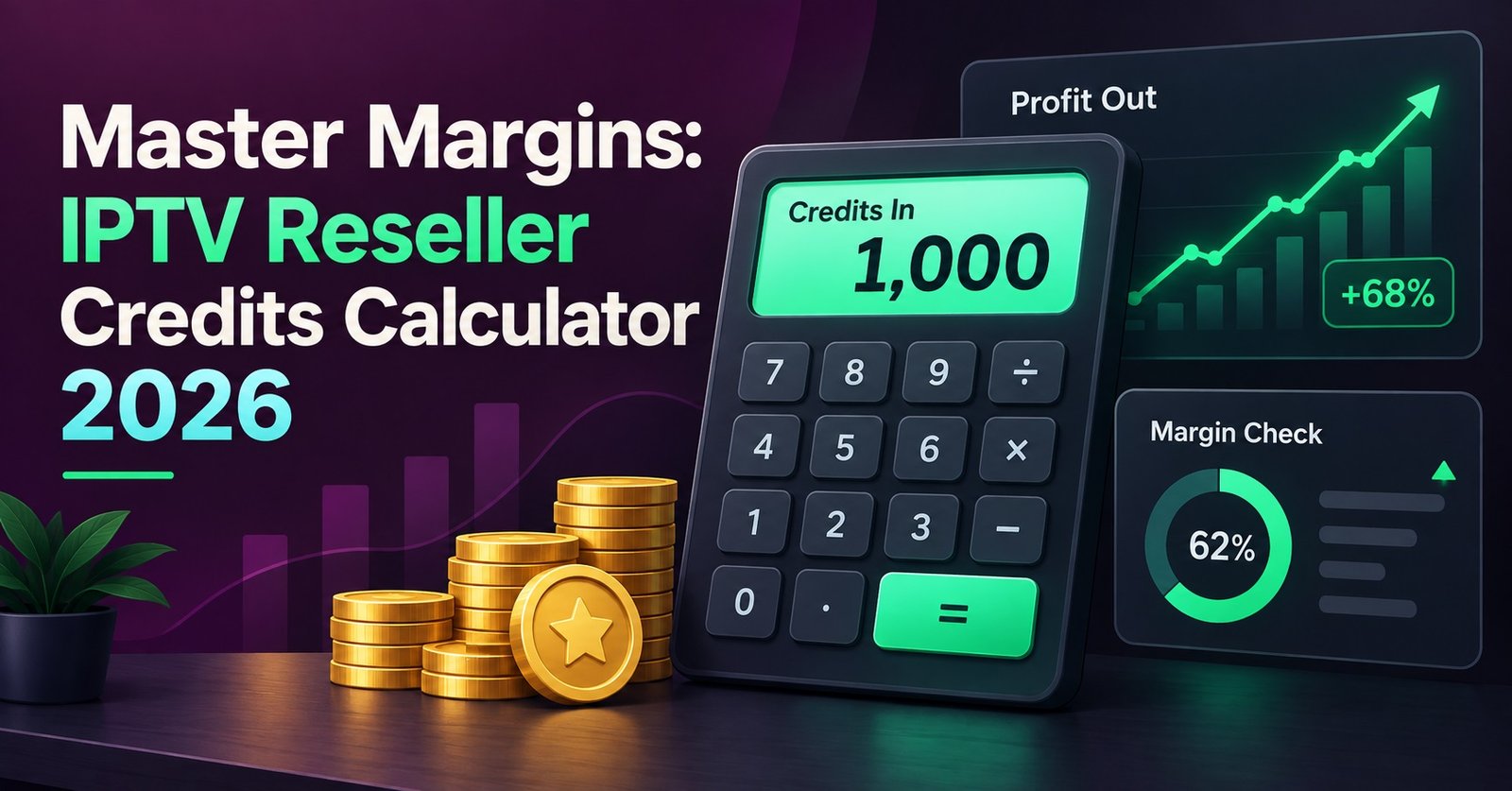

An IPTV Reseller Credits Calculator is simply the maths you use to work out how many credits you need, what each subscriber actually costs you, and what margin is left once renewals and running costs are taken into account. It sounds basic until you’re staring at a pricing page with 30, 50, and 100 credit tiers and no clear idea which one actually suits how many customers you’re serving. Get the sums wrong and you either sit on unused credits or run out mid month with subscribers waiting on renewals.
What an IPTV Reseller Credits Calculator Actually Works Out
Most IPTV Panel resellers use credits on a simple basis: one credit activates one subscriber line for one month. So the calculation isn’t complicated arithmetic, it’s really about matching your credit purchase to your actual subscriber count, plus a buffer for growth and renewals that land before your next top up. The tricky part isn’t the formula itself. It’s the assumptions people plug into it, particularly around how many subscribers renew versus how many drop off after the first month.
The Basic Formula: Credits, Subscribers and Cost Per Line
The core calculation looks like this:
Credits needed = active subscribers + expected new signups before next top up + a small buffer for testing or replacements
Cost per subscriber = total amount paid for credits ÷ number of credits in that pack
That second figure is the one most resellers skip, and it’s the one that actually tells you whether your pricing leaves room for profit. If you’re charging subscribers £10 a month and your cost per credit sits somewhere in the £1.50 to £3 range depending on the pack size and provider, your margin per line is whatever’s left after that, minus any time you spend on support or replacements for dropped connections.
| Subscribers Managed | Credits Needed Monthly | Typical Buffer to Add |
|---|---|---|
| Under 15 | 15 to 20 | 2 to 3 extra |
| 15 to 40 | 40 to 50 | 5 to 8 extra |
| 40 to 100 | 100 to 120 | 10 to 15 extra |
Pro tip: Round up to the next full credit pack rather than the exact subscriber count. Running out of credits mid month costs you more in delayed renewals than a handful of unused credits ever will.
A Worked Example for a Small Reseller
Say you’re managing 22 active subscribers on monthly plans. You expect roughly four new signups before your next credit purchase, and you want a small buffer in case two or three lines need replacing due to a device issue or a customer switching apps. That puts you at 22 plus 4 plus 3, which is 29 credits needed for that cycle. Buying a 30 credit pack covers it with almost nothing wasted. Buying a 50 credit pack because it “seems safer” ties up money in credits that might sit unused for weeks, which matters more than it sounds like when you’re trying to keep working capital free for other costs.
Where Resellers Get the Sums Wrong
The most common mistake isn’t the arithmetic, it’s forgetting that credits get consumed by more than new subscribers. Every time you swap a customer to a new device, reissue a line after a password reset gone wrong, or test a connection before handing it over, that can pull from the same credit pool depending on how the panel is configured. A calculation based purely on subscriber count without accounting for this kind of churn will look accurate on paper and still leave you short by the third or fourth week.
The second mistake is treating the credit price on a pricing page as the whole cost. Card fees, time spent on customer support, and the occasional refund all sit outside the credit calculation but still eat into what you actually keep per subscriber.
Renewal Rates Change the Real Cost, Not Just the Starting One
A calculator built around new signups alone misses half the picture. Once you’ve been running for a couple of months, most of your credit usage isn’t for new subscribers, it’s for renewing existing ones. If seven out of ten subscribers renew each month and three churn, your monthly credit need stabilises around your active base rather than growing indefinitely. This is worth tracking separately from new sales, because a IPTV Panel reseller who only calculates for growth and ignores renewal patterns tends to either overbuy credits early on or get caught out once the subscriber base settles into a steady renewal rhythm.
Pro tip: Keep a simple running note of how many subscribers renewed versus dropped off each month. After three or four cycles, that number is a far better predictor of your credit needs than any fixed formula.
Bulk Buying: When It Actually Pays Off
Larger credit packs usually bring the cost per credit down, which matters once you’re consistently serving 40 or more subscribers a month. Buying 100 or more credits at once can improve your margin per line noticeably compared with smaller top ups bought more frequently. The trade off is cash tied up in credits you haven’t used yet. For a reseller still building their subscriber base, smaller, more frequent purchases usually make more sense than committing to a large pack based on where you hope to be in three months rather than where you actually are now.
View reseller credits plans to see how pack sizes and pricing tiers are structured before working out which size suits your current subscriber count.
Credits Don’t Expire, But That Doesn’t Mean Buy More Than You Need
Some providers let unused credits carry over indefinitely, which removes the pressure of a hard deadline. That’s genuinely useful, but it can also mask a poor calculation. Just because unused credits aren’t wasted money in the sense of expiring doesn’t mean they’re not tying up cash you could have used elsewhere, particularly if you’re a newer reseller still working out realistic subscriber growth.
Reseller Credits Calculator Checklist
- Count your current active subscribers before estimating anything
- Add expected new signups for the coming cycle, not a hopeful guess
- Include a small buffer for device swaps, resets, and replacements
- Divide total pack cost by number of credits to get your real cost per line
- Compare that figure against what you charge subscribers to check your actual margin
- Track renewal versus churn numbers for at least two cycles before trusting a fixed formula
- Reassess pack size every few months rather than sticking with your first choice indefinitely
Frequently Asked Questions
Does one credit always equal one month of service?
On most panels, yes, though it depends on how the provider has set up billing. It’s worth confirming this directly with your provider rather than assuming it matches every panel you’ve used before.
How do I calculate my actual profit per subscriber?
Take what you charge the subscriber, subtract your cost per credit, then subtract any card processing fees or time costs you want to factor in. What’s left is your real margin, not just the headline difference between your price and the credit cost.
Should I buy extra credits for testing new subscribers?
A small buffer helps, particularly if you regularly test a connection before handing login details over. Just don’t let “testing buffer” become an excuse to consistently overbuy.
What happens if I run out of credits before my next top up?
Existing subscribers usually keep working, but you won’t be able to activate new lines or renew others until you purchase more. This is exactly the kind of gap a proper calculation before your subscriber base grows is meant to prevent.
Does a bigger credit pack always mean better value?
Usually the cost per credit drops, but only if you actually use the credits within a reasonable time. Unused credits sitting idle aren’t adding value even if they don’t expire.
Conclusion
An IPTV Reseller Credits Calculator isn’t a complicated tool, it’s a habit of checking your actual subscriber count, expected renewals, and real cost per line before you buy the next pack. Get that right and pack sizing stops being a guess. If you’re weighing up panel options against a straight subscription model first, it’s worth reading through IPTV reseller panel vs subscription before committing to a credits based setup, and checking the about page if you want to see who you’d actually be buying credits from.