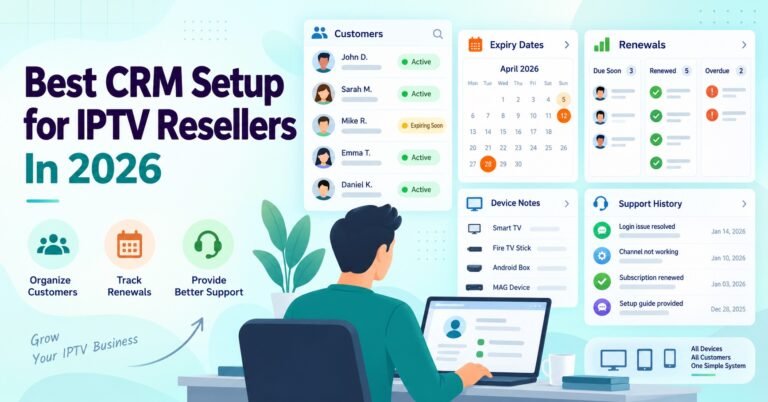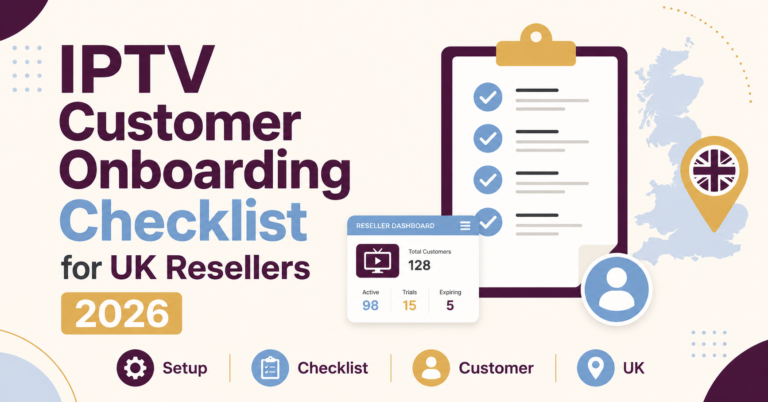
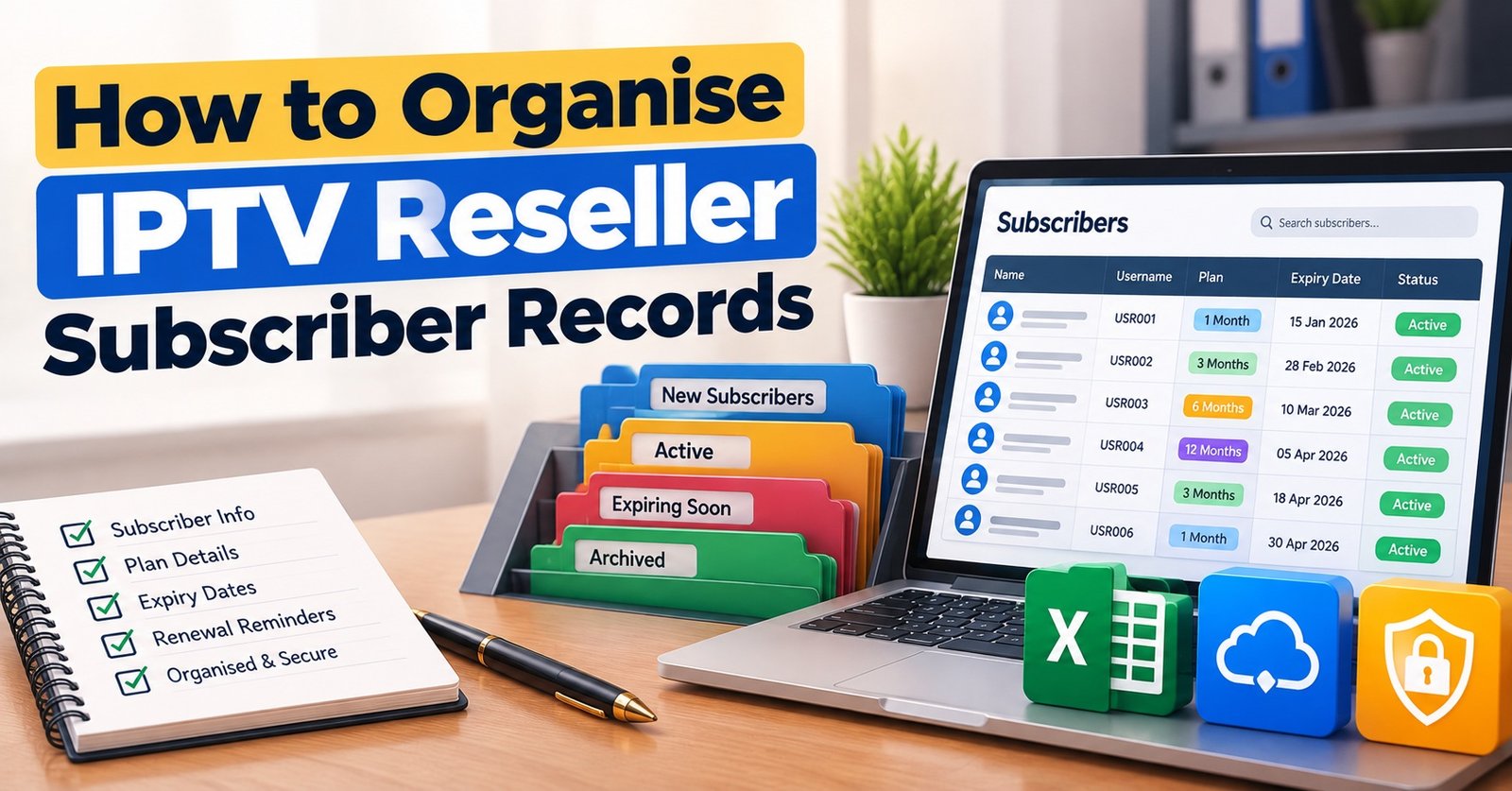

IPTV Reseller Subscriber Records should hold only what you need to activate a line, renew it on time, answer a support query and show what you sold: a customer reference, one contact route, the device in use, key dates and a short support history. Anything beyond that is added risk rather than added information.
Your supplier’s panel is not a substitute for this. The supplier controls what the dashboard displays, how much history it keeps and whether you can still reach an account after a migration or a suspension. A IPTV panel reseller who relies on the panel alone has no record of their own on the day access is lost. A small, separate record that you reconcile against the panel each month lets you settle a renewal dispute or a data request without guessing.
What IPTV Reseller Subscriber Records Cover, and What They Should Not
Think of the record as three kinds of information that are easy to mix up. The first is identity and contact: who the customer is and how you reach them. The second is service detail: which line belongs to them, what device they use, when it started and when it renews. The third is money: what was paid, when, and under which reference. A fourth category, evidence about your own supplier, belongs in a separate place entirely and is covered below.
Most of this counts as personal data, so UK data protection rules apply. The ICO’s guidance on storage limitation is clear that you must not keep personal data for longer than you need it, and that you should be able to justify how long you do keep it. It also says the UK GDPR sets no fixed time limits for different types of data, so the period is your decision to make and defend. That is why a record with a clear purpose for each field is safer than a sprawling one.
| Field | Why it earns a place | Handling rule |
|---|---|---|
| Customer reference | Links every tab without repeating a name | Use it everywhere else instead of the name |
| Name | Addressing the customer, invoicing | One field only |
| Contact route | Renewal notices and support | One primary route, not three |
| Device and app | Faster support triage | Type of device, not serial numbers |
| Line username | Matching the sheet to the panel | Never the password |
| Start and renewal dates | Expiry and credit planning | One consistent date format |
| Payment reference | Proving a payment was received | Reference only, never card details |
| Support log | Spotting repeat faults | Short, factual, no personal circumstances |
Several things should never appear in the sheet. Passwords, card numbers, copies of identity documents and dates of birth have no operational purpose in a subscriber list. Free-text notes deserve particular care, because a casual comment about someone’s health or finances turns a routine record into something far more sensitive.
A record of customers also says nothing about whether the service you resell is properly licensed. IPTV is a delivery technology, and lawful use depends on the distribution rights behind the content. Keep your supplier’s details, agreement date and credit purchase invoices in their own tab or file, so you can show where your supply comes from if anyone asks.
Building the Sheet in Five Steps
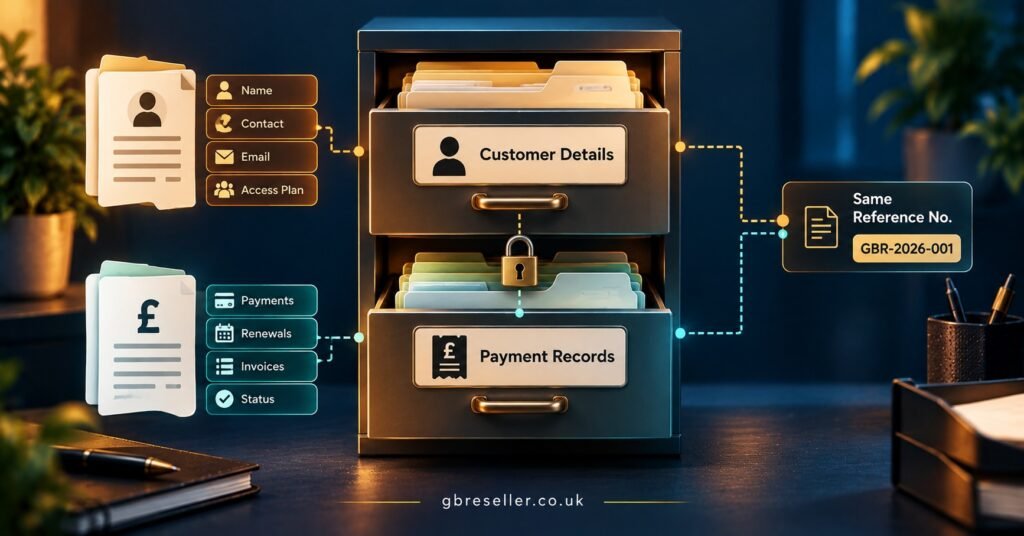
Step 1: Separate the tabs by purpose. Create one tab for subscribers, one for payments and one for your supplier. The reason is practical. When a lapsed customer’s contact details come due for deletion, you can remove them without touching the payment records you may need for tax purposes.
Step 2: Give every customer a reference before anything else. Something like GB-0147 is enough. Use it in the payments tab and in your support notes, so the name and contact route live in exactly one place.
Step 3: Restrict what can be typed. Use drop-down lists for status (active, due, lapsed, closed) and device type, and date validation for renewal dates. Free text is where inconsistency and over-collection creep in.
Step 4: Lock down access. Use a strong, unique password and two-step verification on whichever account holds the file. Share it with named people only, never through an open link, and never email copies around. If the file lives on a laptop or phone, make sure the device itself is protected and encrypted. Check where your chosen spreadsheet service stores data and what its terms say about your content, because you remain responsible for the customer information you put into it.
Step 5: Reconcile monthly. Export or review the line list in your IPTV panel reseller dashboard and compare it with the subscribers tab. Lines in the panel but not the sheet suggest unrecorded sales. Lines in the sheet but not the panel suggest expired or deleted accounts that you have not yet closed.
Pro tip: Add a “Delete contact details after” column that fills itself in when a line is marked closed. You then review a filtered list each month instead of relying on memory.
A Worked UK Example, From First Payment to Deletion
The following is a fictional illustration, not a recommendation of specific periods. It shows how a sole trader in Leeds could lay out the sheet and follow one line through its life.
| Tab and column | Example entry | Rule |
|---|---|---|
| Subscribers: Ref | GB-0147 | Unique, never reused |
| Subscribers: Contact route | WhatsApp, number held in one cell | One route only |
| Subscribers: Device | Streaming stick, living room TV | Type and location, no serials |
| Subscribers: Renewal due | 2026-03-14 | ISO date format |
| Subscribers: Status | Lapsed | Drop-down list |
| Subscribers: Delete contact after | 2026-06-19 | Formula from closure date |
| Payments: Ref and payment ref | GB-0147, bank transfer reference | Reference only |
| Supplier: Credit purchase | Invoice number and date | Kept for accounts |
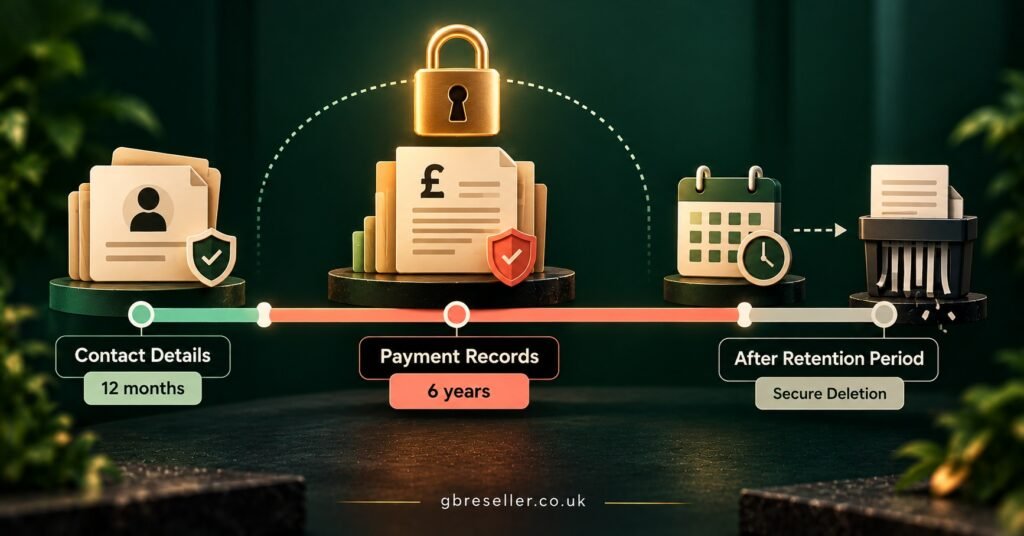
Line GB-0147 was paid for on 2 March 2026 and was due to renew on 14 March. No payment arrived, so after a seven-day grace period the status changed to lapsed on 21 March and the IPTV panel reseller removed the line in the panel. The reseller had decided, and written down in a short retention note, that contact details would be kept for 90 days after closure in case of a late payment or complaint. That put the review date at 19 June 2026, when the contact details and support notes were deleted and the reference alone remained.
The payment record follows a different clock. For a sole trader, the payment falls in the 2025 to 2026 tax year, so the return deadline is 31 January 2027. HMRC’s rules for the self-employed require records to be kept for at least five years after that deadline, which means until at least 31 January 2032. A limited company would instead keep accounting records for six years from the end of the last financial year they relate to, so a company with a 31 March 2026 year end would keep them until at least 31 March 2032. Your accountant can confirm which rule applies to you.
Setting Retention Periods You Can Actually Defend
The sensible approach is to attach a review trigger to each type of record rather than one blanket period for everything.
| Record | Review trigger | Basis |
|---|---|---|
| Contact details and support notes | A fixed period after the line closes, set by you and written down | ICO: no set limit, must be justified |
| Payment and invoice records | Five years after the 31 January deadline (sole trader) or six years from financial year end (limited company) | HMRC and company law |
| Supplier agreements and credit invoices | Same clock as your accounts | Accounting records |
The 90 days in the worked example is a choice, not a rule. A longer period might suit a business that regularly handles late renewals or disputes, and a shorter one might suit a business that rarely does. What matters is that the reasoning is written down and the deletion actually happens. Tell customers how long you keep their details, usually in a short privacy notice.
Mistakes That Cause Real Trouble
Storing line passwords in the sheet is the most damaging habit. If the file leaks, every active account is exposed, and the passwords serve no purpose, because the panel already manages them.
A single master file passed around by chat is the next problem. Copies multiply, nobody knows which version is current, and deletion becomes impossible to prove. One owner and one live file is better, with access shared rather than files sent.
Keeping everything forever “just in case” feels cautious, but the ICO’s position is that data should not be held indefinitely on that basis. Old contact details are simply unnecessary exposure.
Deleting a line in the panel without updating the sheet creates mismatches that quietly distort your credit planning. Reconciliation catches this, but only if it is done on a schedule.
If you work with sub-resellers, each may hold their own customer list. Agree in writing who keeps what and who answers a customer request, because the legal roles depend on who decides how the data is used. Take advice if you are unsure.
A Pre-Launch Checklist for Your Own Sheet
- Each field has a stated purpose, and any field without one has been removed.
- Passwords and card details are confirmed absent.
- Subscribers, payments and supplier records are in separate tabs.
- Every customer has a reference used across all tabs.
- Status, device and date fields use validation.
- Two-step verification is on, and sharing is limited to named people.
- A retention note records each review period and the reason for it.
- A monthly panel reconciliation is in the diary.
- Someone knows how to find and export a single customer’s records on request.
Questions Resellers Ask About Their Records
Do I need to pay the ICO data protection fee?
Most organisations that process personal data must pay it unless an exemption applies. The ICO provides a short self-assessment on its website, so check there rather than assuming.
How quickly must I answer a customer who asks for their data?
Generally within one month of the request, so a sheet where one reference finds everything is a real advantage.
Can I use a cloud spreadsheet?
Yes, provided you control access, use two-step verification and have checked where the service stores data and what its terms say. You remain responsible for the information.
Should I record a customer’s device serial number or network identifier?
Only if you genuinely need it to resolve a fault. Device type is usually enough, and identifiers can themselves count as personal data.
Do my payment records have to be deleted when contact details are?
No. Tax and accounting retention periods are separate, which is why the payments tab should be kept apart.
Does keeping records prove my service is properly licensed?
No. Subscriber records show who you serve. Licensing evidence comes from your supplier and the rights holders, and belongs in the supplier tab.
Where to Start This Week
Good IPTV Reseller Subscriber Records are small, separated by purpose and reviewed on a calendar rather than from memory. Start by removing any field you cannot justify, split payments from contact details, and write down one retention period you are willing to defend. This is general information rather than legal advice, so confirm your position with your accountant or a data protection adviser. Once the sheet is stable, compare it with your credit usage and package costs and your supported device list to keep renewals and support running smoothly.