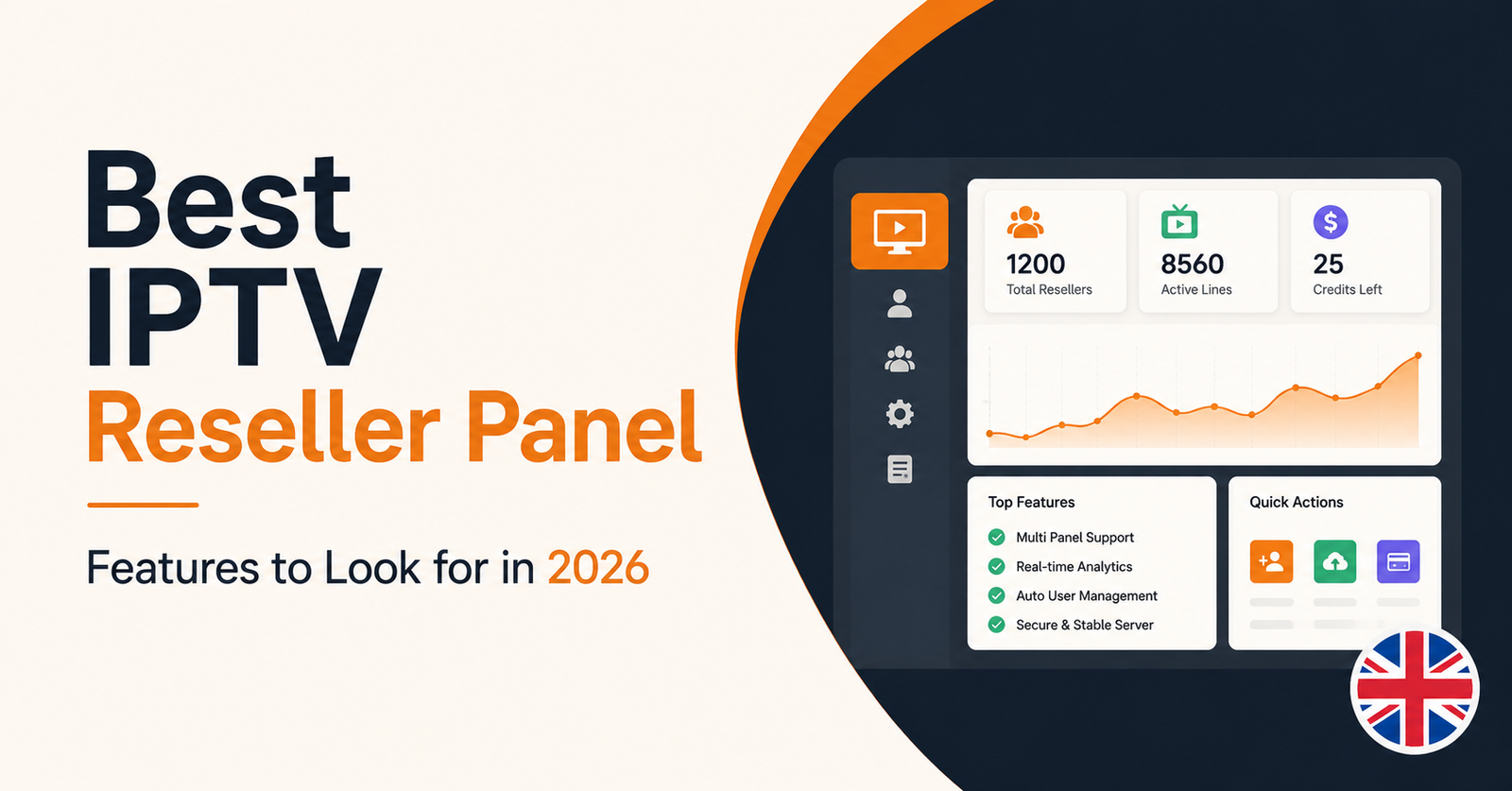

The Best IPTV Reseller Panel Features are the ones that affect your day-to-day running of the business, not the ones that look impressive on a sales page. A panel worth buying gives you a working dashboard, credits that don’t expire on a whim, stable streaming infrastructure, and support that answers before your subscriber has already asked for a refund. Channel counts and glossy screenshots matter less than whether the panel actually holds up when fifty customers log in during a Saturday evening. This guide breaks down which features genuinely change your experience as a reseller, and which ones are just marketing filler.
Why Feature Lists Alone Don’t Tell You Much
Almost every IPTV panel provider publishes a similar feature list: thousands of channels, EPG support, multi-device compatibility, VOD libraries. On paper, most panels look nearly identical. The differences that actually matter show up after you’ve bought credits and started onboarding real customers, which is exactly why so many resellers switch providers within their first few months.
Instead of comparing raw numbers, it helps to group features by what they actually do for your business: control, reliability, content, and support. Each category has a direct effect on how much time you spend firefighting versus how much time you spend selling.
Pro tip: Before comparing feature lists, write down the three problems your last provider caused you. Use that list to filter new panels, rather than starting from a generic checklist.
Dashboard and Account Control Features
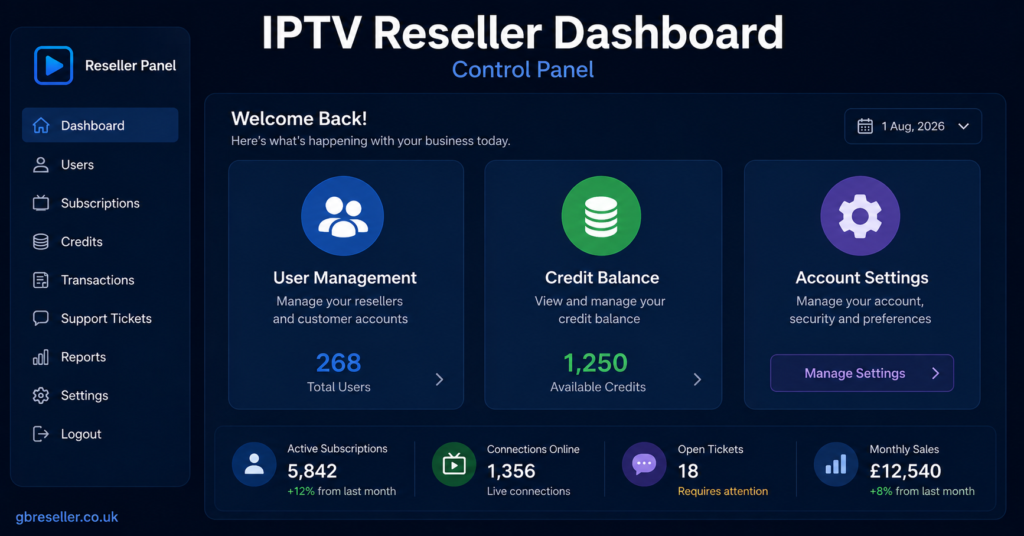
A reseller dashboard is the actual product you’re paying for. Everything else, including the channel list, sits behind it. The features worth checking here include:
- Ability to create, extend, pause, or remove subscriber lines without contacting support
- Bulk actions for managing multiple subscriber accounts at once
- Visible credit balance and usage history
- Sub-reseller account creation, if you plan to let others resell under you
- Basic reporting on which lines are active, expiring, or inactive
A dashboard that requires a support ticket for routine tasks slows you down every single week. If you’re evaluating a IPTV panel reseller setup, ask to see the dashboard before paying, not after.
Best IPTV Reseller Panel Features for Streaming Stability
Streaming stability is where most complaints originate. A panel can have every dashboard feature on this list and still lose customers if the stream buffers during peak hours. Features that genuinely affect stability include:
- Dedicated or load-balanced servers rather than a single shared backend
- Multiple server locations or failover options
- Clear disclosure of concurrent connection limits per line
- Reasonable EPG accuracy, since a broken guide creates more support tickets than almost anything else
No provider can honestly promise zero buffering, and any panel that guarantees this without qualification is worth treating with caution. What you can check is whether the provider explains their infrastructure setup, and whether they’re upfront about limitations rather than dismissing the question.
| Feature | Why It Matters |
|---|---|
| Dedicated servers | Reduces the chance of overload during high-traffic events |
| Documented failover process | Shows there’s a plan when something breaks, not just hope |
| Clear connection limits | Prevents surprise account suspensions for customers |
Pro tip: Ask the provider directly what happens during a server outage, including how long fixes usually take. Vague answers are more telling than confident ones.
Content Library and Device Compatibility
Channel count gets the most attention, but device compatibility and content organisation matter just as much for day-to-day subscriber satisfaction. Worth checking:
- Confirmed support for Firestick, Android TV, Samsung and LG Smart TVs, and generic M3U or Xtream Codes apps
- VOD library that’s actually updated, not a static library from months ago
- EPG that displays correctly across the device types your customers use
- Category organisation that doesn’t bury UK content under dozens of unrelated regions
A large raw channel number means little if half the categories are duplicated or poorly labelled. When you’re testing a panel, spend time browsing the actual EPG and VOD sections rather than trusting the number on the sales page.
Credit Systems and Pricing Flexibility
For a reseller, the credit system is effectively your supply chain. Features worth comparing:
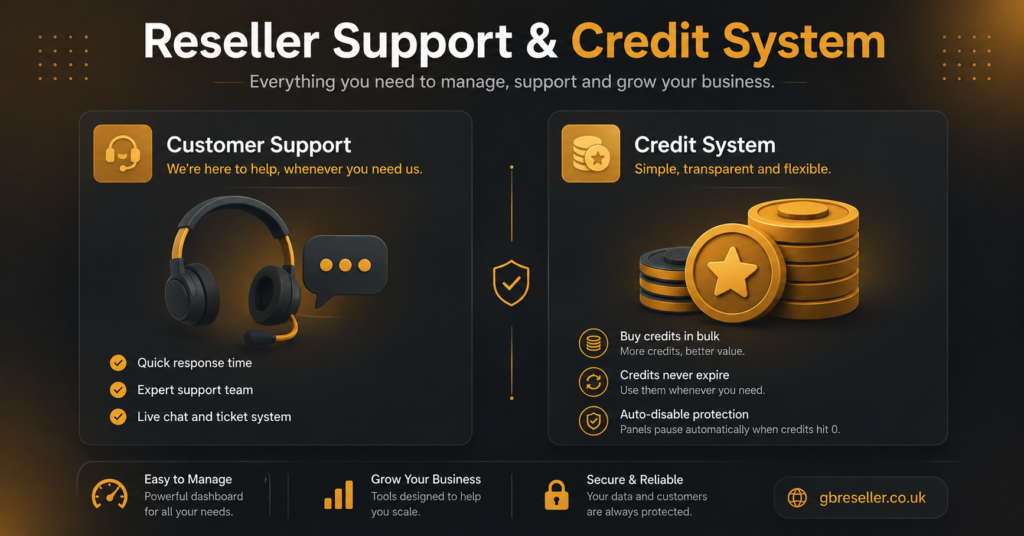
- Credits that don’t expire, or at minimum have a clearly stated expiry window
- Transparent per-credit cost at different purchase volumes
- No retroactive price changes on credits you’ve already bought
- Clarity on what one credit actually activates, since this varies between providers
An IPTV reseller panel with an opaque credit structure makes it difficult to plan your own pricing. If you can’t work out your margin from the pricing page alone, ask before committing to a larger purchase. You can review current credit packages and pricing tiers to see how one provider structures this.
Support Quality as a Feature, Not an Afterthought
Support is technically a service rather than a panel feature, but it belongs on this list because it directly determines how much of your time gets eaten by problems that aren’t your fault. Look for:
- A stated response time, ideally under an hour during business hours
- Direct human contact rather than only automated ticketing
- Escalation paths for issues the front-line team can’t resolve
- Documentation or guides you can send to subscribers instead of repeating the same explanation
Resellers who skip this check often find out the hard way, usually during a live sports weekend when support volume spikes and response times collapse. Reviewing a provider’s full feature breakdown alongside their support policy gives a more complete picture than either alone.
Good Signs and Warning Signs When Comparing Panels
| Good Sign | Warning Sign |
|---|---|
| Provider shows the dashboard before purchase | Only screenshots or a demo video, no live access |
| Clear refund or trial terms in writing | Refund policy only mentioned verbally |
| Realistic uptime language | Guarantees of zero buffering or 100% uptime |
| Direct answers about server setup | Vague or evasive answers about infrastructure |
Pro tip: If a provider won’t answer a direct technical question in writing, treat that as useful information rather than an oversight.
Subscriber View vs Reseller View
Subscribers and resellers care about different things when it comes to panel features, and it’s worth separating the two.
Subscribers mainly notice device compatibility, stream stability, and how quickly a problem gets fixed when something stops working. They rarely see the dashboard or credit system directly, so their experience of “quality” is almost entirely about what happens on screen.
Resellers need to think about the dashboard, credit economics, sub-reseller permissions if applicable, and how support scales when they have dozens of active subscribers rather than one. A feature that’s invisible to a subscriber, like bulk line management, can be the difference between running the business comfortably and spending every evening on admin.
Sub-Reseller Considerations
If you’re operating as a sub-reseller under a parent account, your feature priorities shift again. Permission limits set by the parent reseller, margin per credit, and how much control you have over your own customer base all matter more than raw panel features. Providers such as Skip This are sometimes used as illustrative examples of how sub-reseller hierarchies get structured, though the same evaluation standards apply regardless of which provider is being discussed: check permissions, margins, and support responsibility before agreeing to terms. A guide on setting up sub-reseller accounts covers the practical side of this in more depth.
Common Mistakes When Comparing IPTV Reseller Panels
- Judging a panel purely on channel count without checking device compatibility
- Skipping a test period because the pricing looks attractive
- Not asking what happens to unused credits over time
- Ignoring the credit-to-subscriber ratio when calculating margins
- Assuming a professional-looking website is proof of reliable infrastructure or legal standing
None of these mistakes are unusual. They’re common precisely because feature lists are designed to look reassuring at a glance, and it takes a bit of digging to separate genuine functionality from marketing language.
Questions Worth Asking Before You Buy
| Question to Ask | Why It Matters |
|---|---|
| What’s your average support response time? | Slow support becomes your problem once you have paying customers |
| Do credits expire? | Affects how you plan purchases and cash flow |
| Can I see the dashboard before paying? | Confirms the control features actually exist |
| What happens during high-traffic events? | Reveals whether infrastructure claims hold up under load |
Every legitimate provider should be able to answer these without hesitation. It’s also worth checking a provider’s terms, refund conditions, and business registration details, since content rights and legal distribution permissions ultimately determine whether a service is operating on solid ground, not the quality of its dashboard alone.
Visible FAQ
What are the most important IPTV reseller panel features to check first?
Dashboard control, credit transparency, and support response time tend to affect day-to-day operations more than channel count or advertised extras.
Do more channels always mean a better panel?
Not necessarily. A smaller, well-organised, regularly updated library is often more useful to subscribers than a very large but poorly maintained one.
Should credits expire?
Non-expiring credits, or at least a clearly stated expiry period, give resellers more flexibility to plan purchases around actual demand.
How can I test panel reliability before committing?
Ask for dashboard access or a short trial period, and pay attention to how the provider answers direct questions about infrastructure and support.
Is a professional website proof that an IPTV panel is legitimate?
No. A polished site doesn’t confirm licensing or legal standing. Those depend on content rights and distribution permissions, which are separate from how a website looks.
What should sub-resellers check that resellers don’t need to?
Sub-resellers should focus on the permissions and margins set by their parent reseller, since their control over pricing and customer management is more limited.