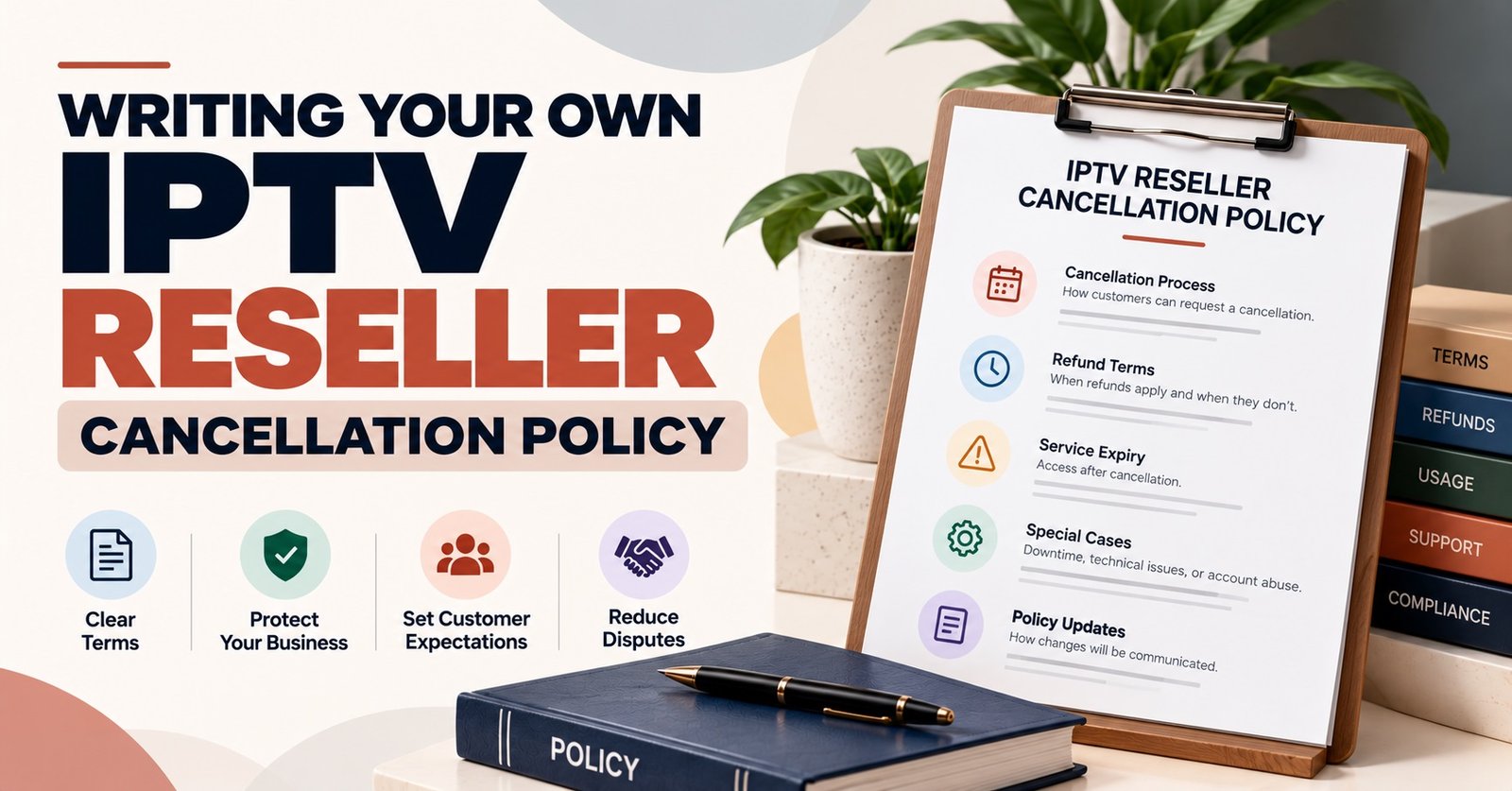

An IPTV Reseller Cancellation Policy covers three separate exits: stopping your own credit purchases, closing a panel account, and cancelling the subscriber lines you have sold to customers. Each one has a different decision-maker, and most confusion comes from treating them as a single event. A provider’s policy usually governs only the first two, while the third is yours to write.
On a credit-based panel there is often no monthly plan to cancel at all, so the practical questions are different. What happens to credits you have not used, whether an empty panel stays open, and what becomes of your live customers if you walk away are the points that cause real disputes. Refund terms are a related but separate document, and it is worth reading them side by side rather than assuming one answers the other.
Three exits that all get called cancellation
The first exit is the quietest. You simply stop buying credits. Nothing is terminated, no form is filed, and the panel sits there until you return. Whether that counts as cancelling depends entirely on how your provider sells its service. If there is no recurring charge, stopping is free and needs no notice.
The second exit is closing the account. This is a deliberate request to remove your dashboard, and it raises questions that a quiet exit never does. Is your remaining balance forfeited, is the data deleted, and who confirms that the closure has happened? If the answers exist only in a chat message, you are relying on memory and goodwill.
The third exit belongs to your customers. A subscriber who tells you they want to stop is cancelling with you, not with your provider. Your provider’s policy has no say in how you treat that request, although it heavily shapes what you can afford to offer.
Why a credit model leaves so little to cancel
Monthly panel rental behaves like any other subscription. It renews, it needs a notice window, and forgetting to stop it costs money. Credit-based supply works differently because each credit activates one subscriber line, and the spend happens at the moment you use it rather than on a calendar date.
That is how the credits plans on the pricing page are described, with no monthly charges and credits and panels that do not expire. Under that kind of model, the cancellation question mostly collapses into one practical point: unused credits are an asset sitting in your account, and the policy should say plainly what happens to them if you leave.
Be careful with that reading when you compare providers. Some bundle hosting, minimum terms or auto-renewing add-ons into the offer, and those do carry notice periods. A policy that sounds simple on a sales page can behave very differently once a recurring element is attached.
What an IPTV Reseller Cancellation Policy should say before you pay
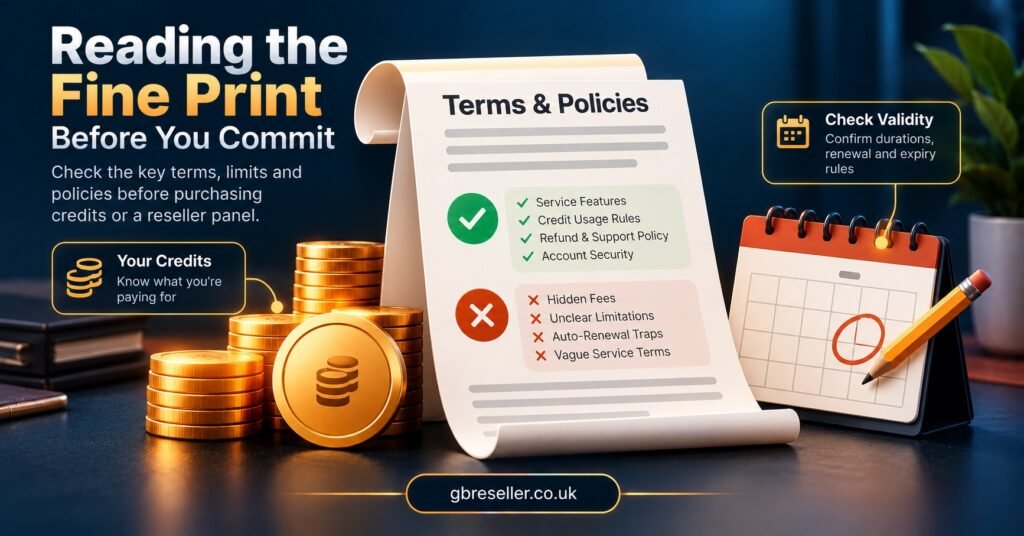
The best time to test a policy is before you hand over money, because afterwards you have very little leverage. A clear policy answers a handful of specific questions in writing, in a place you can find again.
| Question | What a clear answer looks like | Warning sign |
|---|---|---|
| Is there a minimum term or recurring fee? | Stated on the order page, with dates and amounts | Terms appear only after payment |
| What happens to unused credits if I leave? | A written rule on whether they stay, expire or can be refunded | Only “contact us” with no stated rule |
| Can the panel stay open at a zero balance? | A direct yes or no | Silence on the subject |
| Who closes the account, and how? | A named channel and a written confirmation | Verbal instruction only |
| What happens to my live subscriber lines? | Treatment of active customers is addressed | End customers are never mentioned |
Once you have those answers, read two documents together. The terms of service explain acceptable use and what suspension means, including that a suspended panel is not eligible for a refund. The refund policy sets out eligibility separately, including that credits already used to activate lines are not refundable. Treat cancellation, refunds and suspension as three different rules, because a IPTV panel reseller who reads only one of them tends to be surprised by the others.
What happens to your customers if you leave
This is the section most resellers skip, and it is the one with real consequences. Your customers do not have a relationship with your provider. They have one with you, and their lines depend on a panel that you may no longer be funding.
If you stop buying credits but keep the panel, existing lines may carry on until their own period ends. If you close the panel, you should assume those lines stop working and plan accordingly. I would not guess which applies. Ask your provider, get the answer in writing, and then work backwards from it to decide how much notice your own customers need.
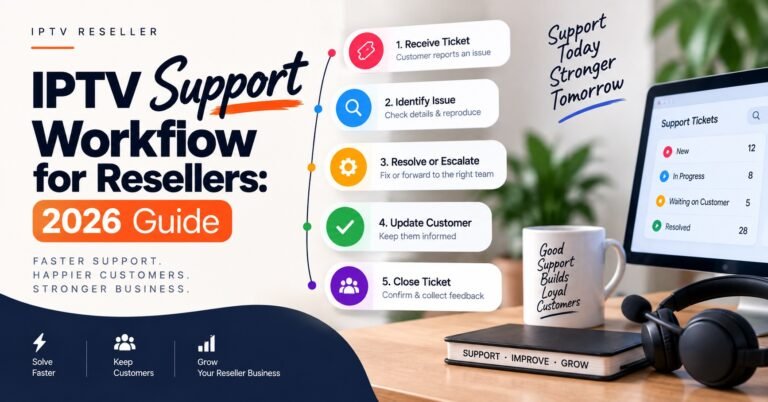
A clean exit looks dull in practice. You tell active customers early, you give them a realistic window, and you do not take new payments for periods you cannot honour. Cancellation requests also arrive through ordinary support channels, which is why building a proper support workflow helps more than any policy page does. A request that sits unanswered for two days feels like a refusal, whatever your policy says.
Writing the policy your own subscribers will see
Your customer-facing policy needs to be built from your costs, not copied from someone else’s page. When you activate a line, a credit is gone from your balance. If you then promise a full refund after three weeks, you are paying that refund out of your own pocket, because your provider is unlikely to return the credit.
So start from what you can recover. Decide when a customer can cancel, whether unused time is refunded and in what proportion, how they should ask, and how you will confirm the cancellation in writing. Keep the language plain, and publish it before the first sale rather than after the first dispute.
Pro tip: Write your own policy only after you have read your provider’s. Any promise you make to a customer that your provider does not mirror is a cost you carry alone.
It also helps to understand what a cancelled line actually costs you over time. Customer lifetime value and credit pricing decisions is useful here, because a generous cancellation rule on a low-margin line can erase the profit from several others.
Consumer law, and where it stops applying
Two different legal positions sit inside one transaction. When you buy credits for your business, you are generally acting as a trader, and consumer cooling-off rights are not normally designed for that purchase. Your own customers are different. If they are private individuals buying online, your sales to them may fall under the UK’s Consumer Contracts Regulations, which provide a 14-day cancellation period for distance contracts, with exceptions that can reduce or remove that right once a digital service has begun with the customer’s agreement.
The rules are also in motion. Government has said the new subscription regime under the DMCC Act is expected to commence in spring 2027, adding clearer pre-contract information, reminders and easier exits for consumers on subscription contracts. Nothing in your setup needs to change today because of that, but a monthly plan sold to UK consumers is the sort of arrangement it is aimed at.
If you sell in Australia, Canada, Ireland or the United States, the position differs again, so check local requirements rather than assuming UK rules travel. This is general information rather than legal advice, and anything involving a dispute is worth putting to a qualified adviser. One more point belongs here: a tidy cancellation policy says nothing about whether a service is lawful, because IPTV is a delivery technology and the legality of any content depends on rights, permissions and local requirements.
Before you commit or walk away
A good IPTV Reseller Cancellation Policy is mostly about what is written down: whether unused credits survive, whether an empty panel stays open, how an account is closed and what happens to live customers. On a credit-based panel with no monthly fee, leaving can be as simple as not buying again, but only if the provider states that clearly. Where a plan includes recurring elements or a minimum term, the notice period matters far more than the sales page suggests.
The sensible next step is to read the provider’s terms and refund policy together, ask any unanswered question by message so the reply is on record, and only then write your own customer-facing rules. Your policy should never promise more than your provider will honour.
Account Exit Checklist
- Ask in writing what happens to unused credits and keep the reply
- Confirm whether the panel stays open at a zero balance
- Check for any minimum term, recurring add-on or notice period
- List your active subscriber lines and their end dates
- Tell customers early, with a realistic window to move on
- Stop taking payments for periods you cannot honour
- Request written confirmation once the account is closed