
Good IPTV Reseller Account Naming comes down to one rule: a subscriber line’s username should identify the account to you and reveal nothing about the person to anyone else. Build each login from a short structured code, such as a brand prefix, a running number and a random tail, keep the customer’s real details in a separate record linked to that code, and never create a username from a name, phone number, email address or postcode.
A line username travels much further than most resellers expect. It is typed into apps on shared family devices, read aloud during support calls and, with the M3U link format used by Xtream Codes style panels, written straight into the playlist URL next to the password, where it can turn up in screenshots, router logs and forwarded messages. A login such as “sarahjones07700” exposes a real person every time that happens. A code such as “NBA0142K7” exposes nothing, yet still tells you at a glance which customer, which sub-reseller and which renewal history you are dealing with.
What a Line Username Actually Has to Do
Every username you create on an IPTV reseller panel is doing three jobs at once, and most naming problems come from designing for only one of them.
First, it authenticates. The subscriber or their installer enters it into a player app, often on a television remote, so it needs to be easy to type and impossible to misread. Second, it must be unique on the server. Many panels sit on infrastructure shared by a large number of resellers, so an obvious name like “john1” may already belong to someone else’s customer, and the panel will simply refuse it. Third, it must be traceable inside your own business, so that when a renewal payment arrives or a fault is reported, you can find the right line in seconds rather than scrolling through a list of near-identical entries.
It also helps to separate the different kinds of “account” that tend to get lumped together:
- Subscriber line usernames, the logins your customers use on their devices.
- Line passwords, which should be generated independently and never derived from the username.
- Notes or label fields, which some dashboards offer for internal reference and which are visible to anyone with panel access.
- Your own reseller login and any sub-reseller logins, the accounts used to manage the panel itself.
A naming convention should cover all four, but the subscriber line username is where the privacy and duplication risks are concentrated, because it is the only one that leaves your control. If you want a refresher on where each of these sits in the interface, the guide to how an IPTV reseller dashboard handles subscriber lines walks through the main screens.
Building an IPTV Reseller Account Naming Convention, Step by Step
The steps below produce a username format you can use for years without rewriting. Take them in order, because the early decisions limit the later ones.
Step 1: Find out what your panel accepts
Before designing anything, create a test line (or check the provider’s documentation) to confirm the rules: minimum and maximum length, whether hyphens or underscores are allowed, and whether usernames are case-sensitive. Panels differ, and some player apps handle special characters badly when the credentials end up inside a URL. Sticking to letters and numbers keeps you safe across almost every app and device.
Step 2: Choose a short prefix
Two or three letters that identify your brand are enough. If you run sub-resellers, add one more character that identifies who created the line. Use a neutral letter or number for each sub-reseller rather than their initials, because people leave and their initials stay on hundreds of lines.
Step 3: Add a running number that never resets
A four-digit sequence (0001, 0002 and so on) gives you an order of creation and an easy way to say “line 142” on the phone. Never restart the count each year or each month, and never reuse a number from an expired customer. The number is a permanent reference, not a slot to be recycled.
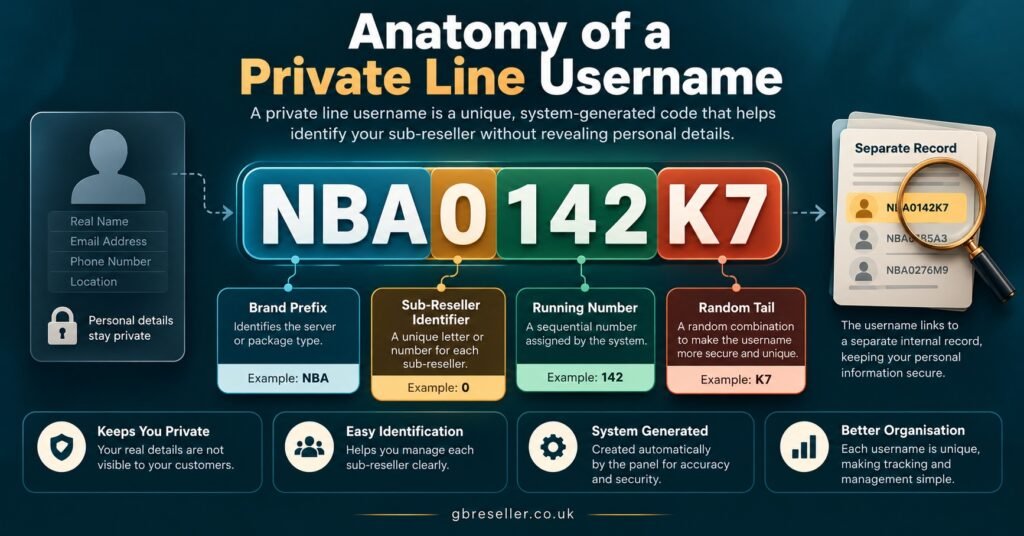
Step 4: Add a random tail to prevent collisions
Two or three random characters at the end solve two problems. They make a clash with another IPTV panel reseller’s username on a shared server very unlikely, and they stop anyone guessing neighbouring accounts by counting upwards from their own. Draw the tail from a reduced character set that leaves out easily confused characters: drop O and 0, I, l and 1, and S and 5 if your customers often read credentials aloud.
Pro tip: Keep all usernames in one case, ideally upper case. Even where the panel treats case as significant, customers typing on a remote rarely notice the difference, and a single-case scheme removes a whole category of “it says invalid login” support tickets.
Step 5: Generate the password separately
The password should be random, created at the same moment as the line, and unrelated to the username or the customer. A password built from a pattern (“NBA0142pass”) undoes all the work of a careful username scheme.
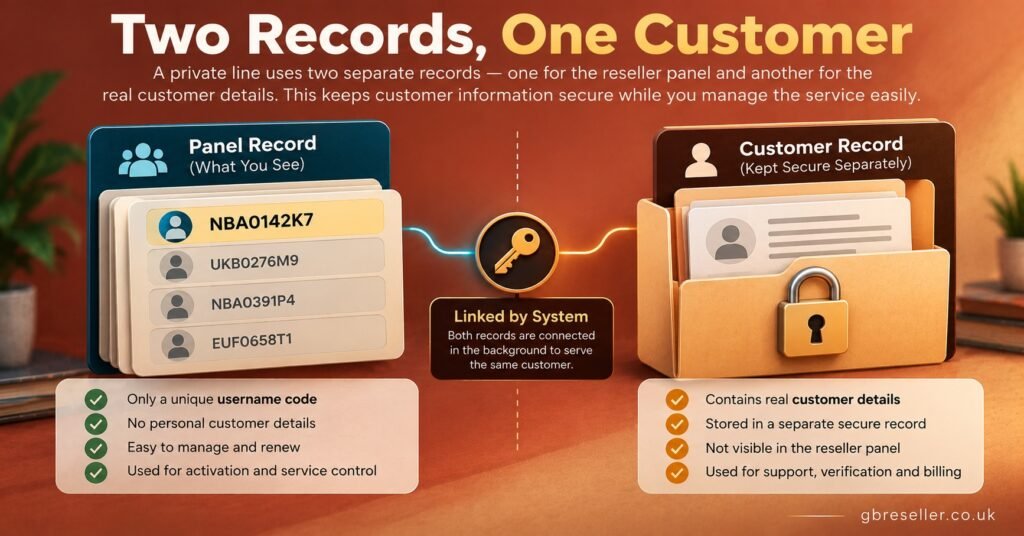
Step 6: Keep the link to the real customer somewhere else
The customer’s name, contact details and payment history belong in a separate, access-controlled record, such as your CRM or a protected spreadsheet, where the line code is simply one column. This mirrors what UK data protection guidance calls pseudonymisation: individuals cannot be identified from the dataset itself, but can be identified by referring to other information held separately. Be clear about what that does and does not achieve, though. Pseudonymised data is still personal data and must be protected accordingly, and good practice is to store the information that re-links the codes securely and apart from the coded data. The naming scheme reduces exposure; it does not replace basic security on your records.
A Worked UK Example: One Reseller, Two Sub-Resellers
To show how the steps fit together, take a hypothetical reseller in Leeds trading as “Northbank Media”. The owner creates lines directly and also supplies credits to two sub-resellers. The business is invented for illustration; the template is what matters.
The convention they settle on is: brand prefix (NB), creator letter (A for the owner, B and C for the two sub-resellers), a four-digit running number, and a two-character random tail.
| Segment | Example | What it tells you |
|---|---|---|
| Brand prefix | NB | The line belongs to Northbank Media |
| Creator letter | A | Created by the owner, not a sub-reseller |
| Running number | 0142 | The 142nd line ever created under this creator |
| Random tail | K7 | Prevents clashes and guessing |
So the owner’s 142nd line becomes NBA0142K7, while the seventh line created by the first sub-reseller becomes NBB0007M4. Nothing in either code reveals who the subscriber is, where they live, or when they joined.
Their separate customer record, kept in a password-protected spreadsheet that only the owner can open, looks like this:
| Line code | Customer record | Status note |
|---|---|---|
| NBA0142K7 | C-0088 | Paid line, renewed October 2026 |
| NBA0143R2 | C-0089 | Started as a trial, converted on the same line |
| NBB0007M4 | C-0090 | Managed by sub-reseller B |
The customer reference (C-0088 and so on) points to the row holding the person’s name and contact details, which never appears in the panel at all. When the customer messages to say their renewal is due, the owner searches the spreadsheet by name, finds NBA0142K7, and goes straight to that line in the dashboard.
Two operational rules complete the scheme. Trials are created with the same format as paid lines, so a trial that converts keeps its username and the customer does not need to reconfigure any devices. Where a panel cannot convert a trial and a new line has to be created, the new code is noted against the same customer reference so the history stays in one place. And because each line uses one credit when it is activated, the running number doubles as a quick cross-check against how IPTV reseller credits are spent on each line: if the count of lines created this month does not match the credits used, something has been duplicated or deleted.
Where Naming Schemes Usually Break
Most problems with line naming do not appear on day one. They surface months later, when there are hundreds of lines and a few staff members involved.
Personal details in the username. Names, mobile numbers, house numbers and postcodes are the most common shortcuts, and the most damaging. They save a few seconds when creating the line and then sit inside every playlist URL and app screen for the life of the account.
Recycling an expired customer’s login. Reusing a username and password for a new customer is tempting when a short code is “free” again. The risk is that the previous customer’s devices may still have those credentials saved, and when the line becomes active, an old device starts drawing on the new subscriber’s connection allowance. Retire codes permanently.
Renaming lines mid-life. Changing a username forces the subscriber to re-enter credentials on every device. Get the format right before scaling, and if you must change convention, apply the new format only to newly created lines.
Dates baked into the name. A code like “NB-OCT26-14” looks tidy until the line is renewed for another year and the date no longer means anything. Expiry belongs in the panel’s expiry field and in your records, not in the username.
Purely sequential codes with weak passwords. “NB0001”, “NB0002” and “NB0003” invite anyone with one valid login to try the next. The random tail and a properly generated password close that gap.
Sub-resellers inventing their own format. If each sub-reseller names lines their own way, the parent account becomes very hard to audit. Agree the convention, including the creator letter, before handing over credits.
Treating tidy names as a compliance answer. A careful naming scheme protects customer privacy and keeps the IPTV reseller panel business organised, but it says nothing about whether the content on a service is properly licensed. That question rests on the provider’s distribution rights, and naming discipline is no substitute for checking them.
Before You Create the Next Line
- Confirm the panel’s length limits, allowed characters and case rules with a test line.
- Write the convention down in one sentence that any team member or sub-reseller can follow.
- Assign each sub-reseller a neutral creator letter or digit, not their initials.
- Use a running number that never resets and never reuses a retired code.
- Add a random tail drawn from a character set without look-alike characters.
- Generate the password separately, at random, with no link to the username.
- Record the line code against a customer reference in a separate, access-controlled file.
- Keep personal data out of the panel’s notes field as well as the username.
- Match the number of lines created against credits used at the end of each month.
Questions Resellers Ask About Line Names
Can I change a subscriber’s username after the line is live?
Some panels allow it, but every device the customer has set up will stop working until the new credentials are entered. It is usually better to leave existing lines as they are and apply a new convention only to lines created from now on.
Should I let customers choose their own username?
It is generally safer not to. Customers tend to pick their own name or a variation of an email address, which defeats the privacy purpose, and popular choices are more likely to clash with existing usernames on a shared server.
Is a coded username enough to protect customer privacy?
It removes the most obvious exposure, but it is only one layer. Under UK data protection law, information that can be linked back to a person through a separate record is still personal data, so the file holding names and contact details needs proper access control too.
What should I do if the panel says my username is already taken?
That is a sign the code is too short or too predictable for a shared server. Adding or lengthening the random tail normally fixes it, and it is worth regenerating the tail rather than tweaking the code by hand, so the format stays consistent.
Do I need a convention for my own reseller and sub-reseller logins as well?
Yes, though the priorities differ. Those accounts control credits and lines, so strong unique passwords and a clear record of who holds each login matter more than the format of the name itself. When a sub-reseller relationship ends, change or disable that login rather than renaming it for someone else.
Getting the Name Right Once
IPTV Reseller Account Naming is one of those decisions that costs nothing to get right at the start and a great deal to fix later. A short code built from a prefix, a creator marker, a permanent running number and a random tail keeps customers’ identities out of playlist links and support screenshots, avoids collisions on shared servers, and gives you a clean reference for every renewal, fault and credit check.
Pair it with a separately secured customer record and a written rule your sub-resellers follow, and the panel stays readable however large the UK IPTV reseller operation grows. If you are setting up a new panel and want to see how lines, credits and sub-reseller accounts sit together in practice, the UK IPTV reseller panels from GB Reseller are a sensible place to compare options.