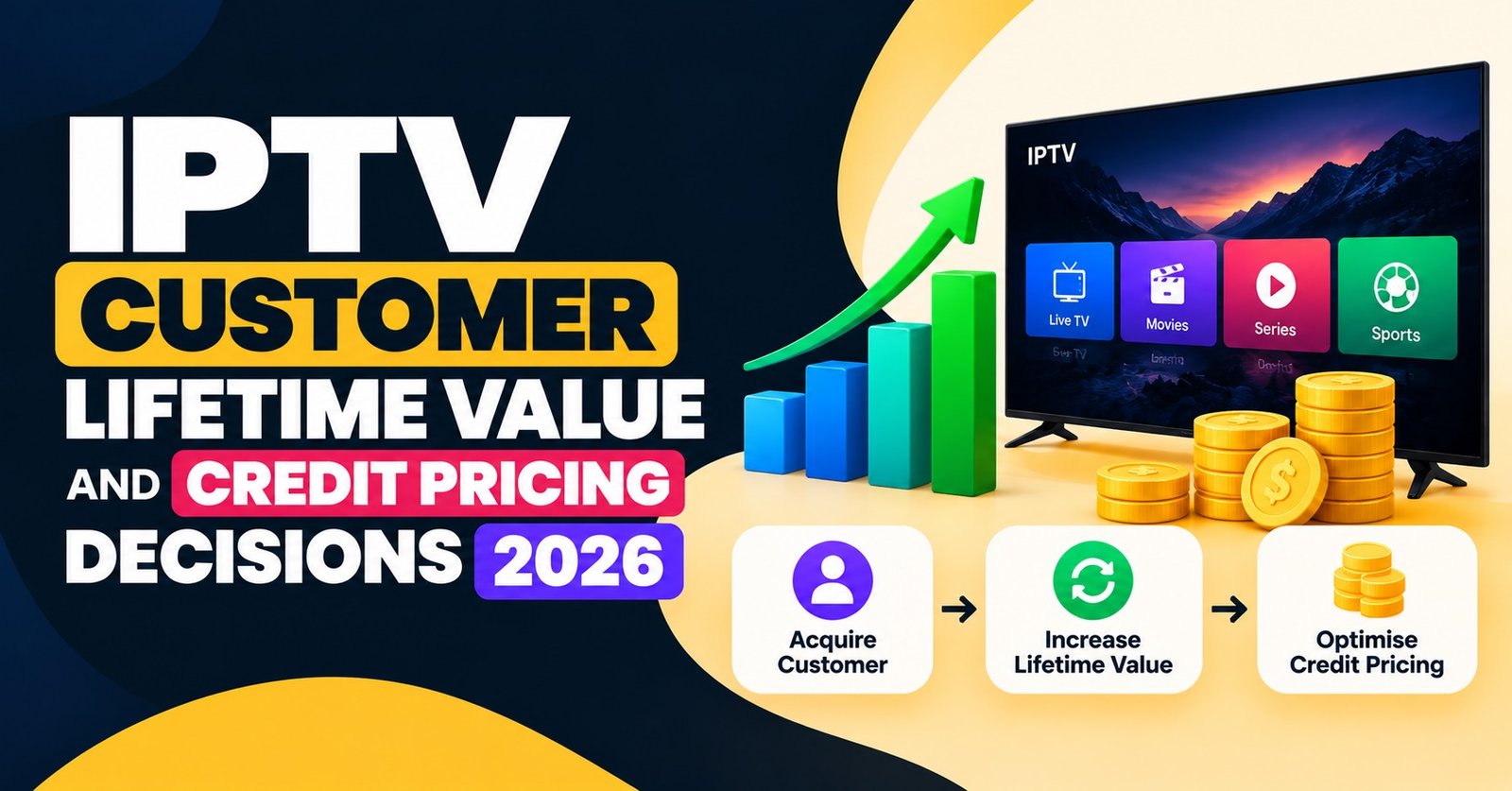

IPTV Customer Lifetime Value is the total profit one subscriber line earns you between first activation and the day it stops renewing, after taking off what it cost you to win and serve that customer. In its simplest form, you take the margin on each renewal, multiply it by the average number of renewals, and subtract the acquisition and support cost.
Most IPTV panel resellers never work this out because the panel dashboard shows active lines, not profit per customer. The first thing to check is whether you are counting revenue or margin, since revenue flatters every line and hides the credits you spent. The second is where your renewal history lives, because without start and end dates for each line, the number you calculate will be a guess.
IPTV Customer Lifetime Value in plain arithmetic
There are only four inputs. The first is what the customer pays per renewal. The second is what that renewal costs you, which for a credit-based panel means the credit you spend plus any payment fees. The third is how many renewals the average customer completes. The fourth is the one-off cost of getting that customer in the first place, whether that is advertising, a free trial period, or time spent on onboarding.
Here is a worked example using round numbers chosen only to show the arithmetic, not as benchmarks. A customer pays £10 per renewal. The credit and fees cost you £4, so the margin is £6. If the typical customer renews eight times, that is £48. Take off £8 for acquisition and onboarding, and the lifetime value is £40.
Change one input and the answer moves a long way. If the average customer renews only four times, the same line is worth £16. Many resellers find the renewal count matters more than the price, which is why a small rise in retention often beats a small rise in price.
Two cautions apply. First, do not average everyone together if you sell different durations, because a customer who pays for twelve months upfront behaves very differently from one who pays monthly. Second, a young reseller business has not yet seen enough completed customer lifecycles, so any figure you produce early on is a working estimate. Treat it as one and revisit it as more lines reach their natural end.
Why a line count tells you almost nothing
A panel showing 300 active lines sounds healthy, but it cannot tell you whether those lines are long-standing customers, a wave of recent trials, or a handful of heavy users paying for several connections. Two resellers with identical line counts can have lifetime values that differ by a factor of three.
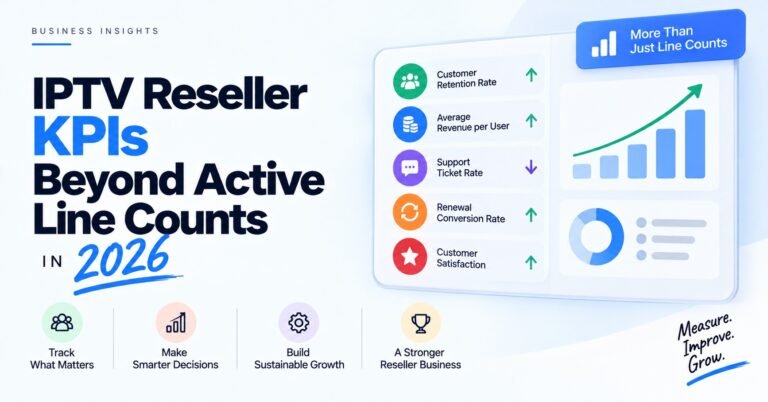
This is the argument behind looking at IPTV reseller KPIs beyond active line counts. Lifetime value sits alongside renewal rate and churn as one of the few measures that explains why your income is rising or falling, rather than just reporting that it is.
Where lifetime value quietly leaks
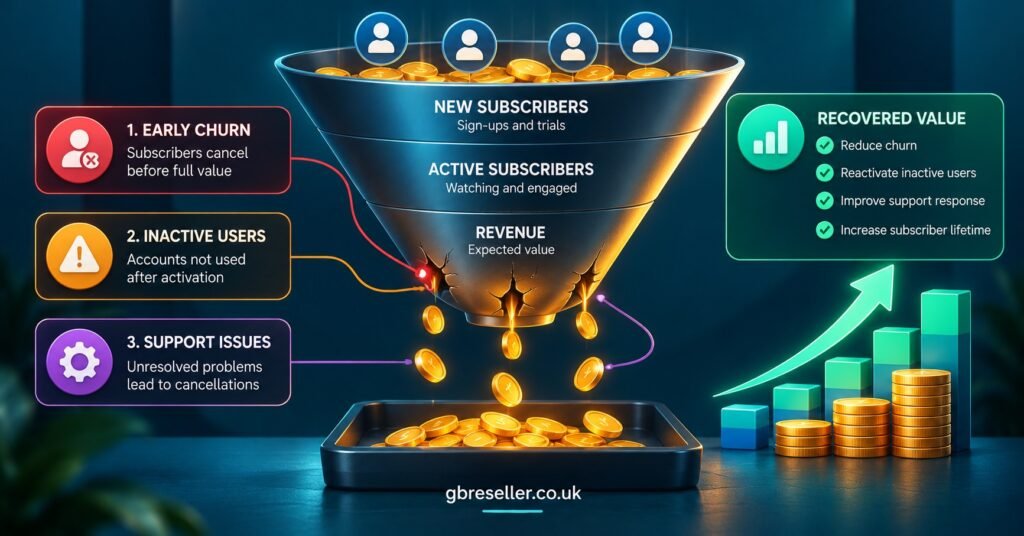
Most of the lost value comes from small, repeated problems rather than one dramatic failure. The table below pairs the usual leaks with what they look like in your records and the most sensible fix.
| Leak | What it looks like | Better handling |
|---|---|---|
| Missed renewal window | Lines expire and the customer never returns | Send a reminder before expiry, not after |
| Slow first response | Cancellation within the first renewal period | Reply to setup problems the same day |
| Discounting to win back | Margin shrinks while the line count looks fine | Offer a reason to stay, not a permanent cut |
| Free trials that never convert | Many starts, few paid renewals | Track trial-to-paid separately from normal lines |
| Unresolved repeat faults | Same customer contacts support several times, then leaves | Log the pattern and fix the cause at source |
Notice that none of these require a change of provider or a price cut. They are operational habits, and they are cheaper to correct than acquiring replacement customers.
Credits change the sum, and many people forget it
On a credit-based panel, your cost per renewal is not a monthly bill but the price you paid per credit. That makes bulk purchasing part of your lifetime value calculation. If you buy credits in larger batches, your cost per renewal falls, and the same customer becomes more profitable without any change in behaviour on their side. Looking at your credit plans is therefore a lifetime value exercise as well as a purchasing one.
There is a trade-off worth stating plainly. Buying a large batch lowers cost per renewal but ties up cash, so it only makes sense if your renewal flow is steady enough to use them. Unused credits are not a loss in themselves where they do not expire, yet they are money you cannot spend elsewhere.
Also remember that subscriber content access depends on rights and permissions held by the underlying services, and resellers should only offer services they are properly authorised to supply. Lifetime value built on a service that may be withdrawn is not a stable number.
Pro tip: Calculate your cost per renewal using the average price you actually paid per credit across recent purchases, not the cheapest bulk price you hope to reach.
Support cost is part of lifetime value, not a separate topic
A line that needs six conversations in its first month has a different value from one that needs none, even if both pay the same price. Support time costs real money, either as your own hours or as someone else’s wage, and it should come off the margin.
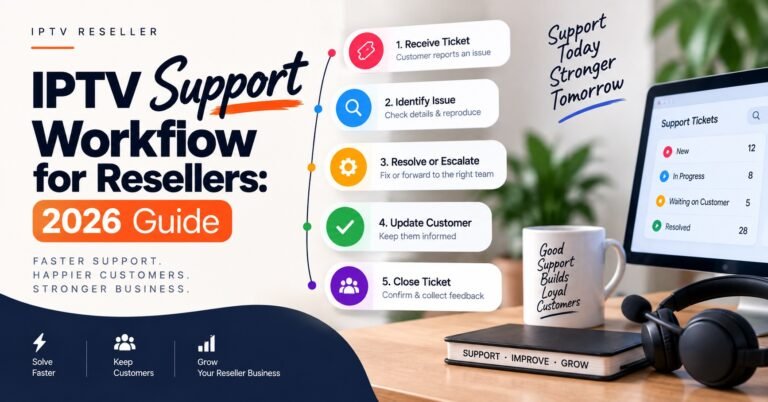
This is why the structure of your handling matters. A clear support workflow for IPTV panel resellers reduces the repeat contacts that eat into margin, and it also protects the first-renewal moment, which is where many customers decide whether to stay. If you do not currently record why customers contact you, start with a simple category note on each conversation. After a few weeks you will see which faults cost you the most.
Which customers deserve your attention first
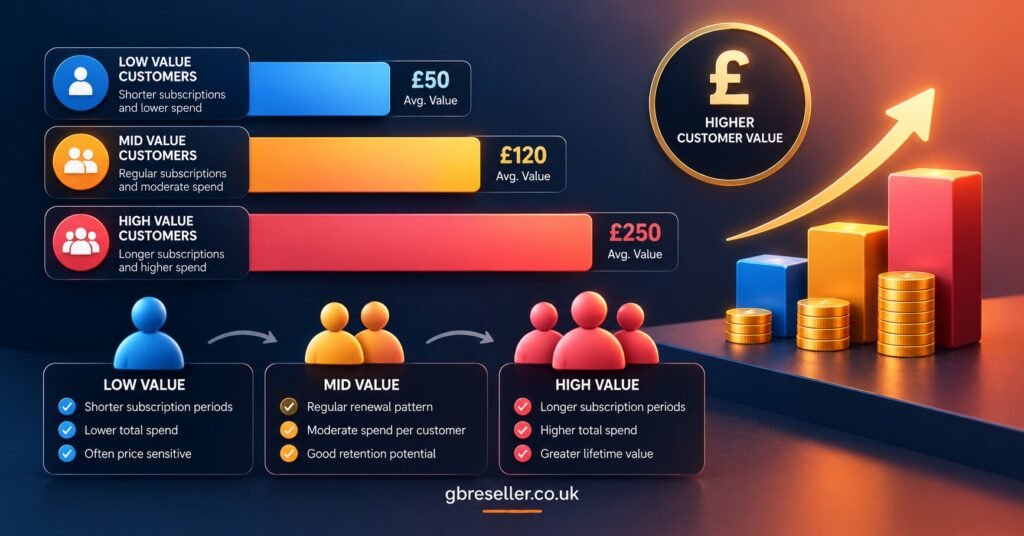
An average hides the extremes. Some of your customers renew on time every period and never message you, while others cost more to look after than they return. Sorting them into groups, as described in IPTV customer segmentation for resellers, lets you calculate lifetime value for each group rather than for a blended crowd.
Segments that often behave differently include customers on long prepaid terms, customers on short terms, households with several connections, and customers who arrived through a referral rather than advertising. Referred customers often cost less to acquire, though you should confirm that from your own records and not assume it.
Pro tip: Calculate lifetime value separately for your two largest customer groups before doing anything else. The gap between them usually shows where to focus.
Turning the number into decisions
A lifetime value figure is only useful if it changes something you do. There are three decisions it should inform.
The first is how much you can spend to acquire a customer. If a customer is worth £40 over their lifetime in your records, spending £25 to win them leaves very little room, and spending £8 leaves plenty. Never let acquisition spend creep up without checking it against the figure.
The second is how you handle price changes. A small increase on a loyal group may cost you few customers, whereas the same increase on a group that already churns quickly can accelerate their departure. Segment first, then decide.
The third is where to invest effort. Improving the first-renewal rate usually adds more lifetime value than any other single action, because every later renewal depends on it. A friendly check-in before the first expiry, handled calmly and without pressure, is a modest cost against that outcome.
Frequently asked questions
Should I measure lifetime value in revenue or profit?
Use profit, meaning margin after credit cost and fees. Revenue-based figures overstate the value of every customer and make weak acquisition spending look acceptable.
How many months of data do I need before the figure means anything?
There is no fixed number. You need enough completed customer lifecycles to see a real average, and the more your customers vary in term length, the more data you need. Until then, keep the figure as an estimate.
Does a longer subscription term always raise lifetime value?
Not automatically. Longer prepaid terms bring cash forward and reduce renewal decisions, but they can also hide dissatisfaction until the end of the term. Check what happens at the first renewal after a long term.
Can sub-resellers use the same calculation?
Yes, though their cost per renewal includes the price charged by the parent reseller panel, and their margin is usually narrower. They should be especially careful about support cost because they have less room to absorb it.
What is a sensible way to treat free trials?
Count the cost of a trial as acquisition spend, then track what share convert into paid renewals. A trial with a poor conversion rate is an expense, not a free gift.
Conclusion
IPTV Customer Lifetime Value is not a complicated sum, but it only helps if you build it from margin, real renewal history and honest support cost. Start with your two biggest customer groups, work out the figure for each, and compare it with what you spend to win new customers. Where the number is weaker than you expected, the first fix is usually retention at the first renewal, not a price change. Revisit the calculation every quarter as more customer lifecycles complete, because the answer will keep moving.
Reseller Checklist
- Record start date, end date and renewal count for every line
- Work out your real cost per renewal from recent credit purchases
- Separate trial customers from paid customers in your records
- Note the reason for each support contact, even briefly
- Calculate lifetime value for each customer group, not only one average
- Compare acquisition spend with the figure before increasing it
- Review the number each quarter and adjust as new data arrives