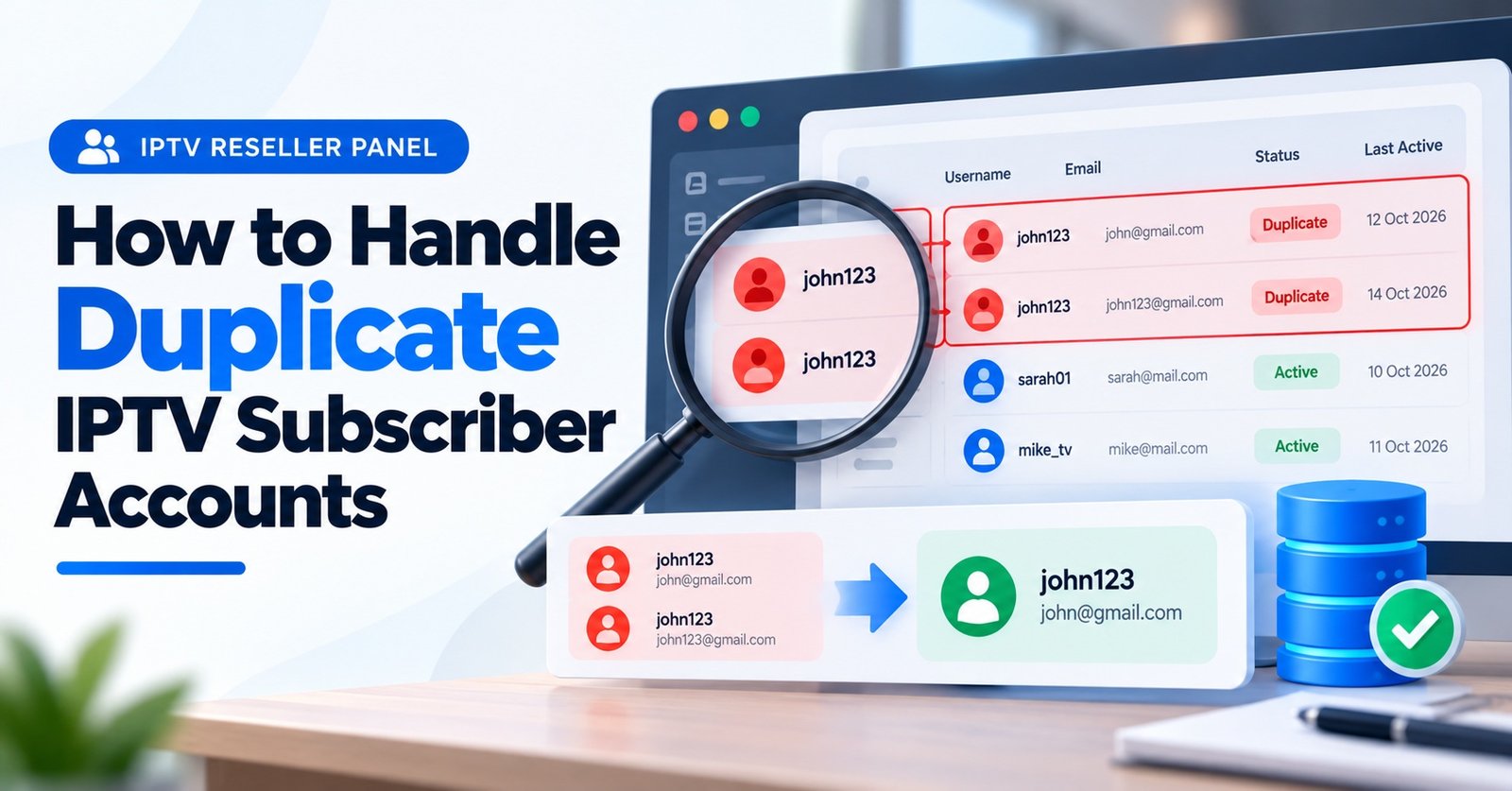

The quickest way to Handle Duplicate IPTV Subscriber Accounts is to stop before deleting anything. Confirm that both lines really belong to the same person, check which one their devices are actually connected to, keep that line as the survivor, and disable the other rather than removing it until you know whether its credits can be recovered or reused. Then correct your records, because a duplicate that is fixed in the panel but not in your spreadsheet tends to come back at the next renewal.
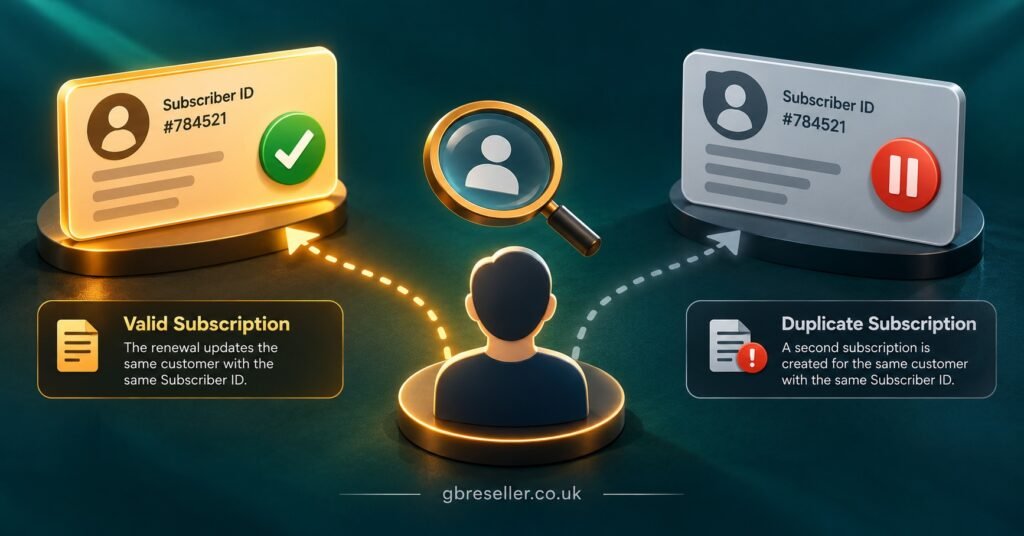
Not every pair of matching names is a mistake, though. A customer with a flat in one city and a parent’s house in another may genuinely need two separate lines, and a household that asked for more screens may have been sold an extra line when extra connections on the original would have done. The real test is whether both lines are meant to exist. If nobody can explain why the second one was created, treat it as a duplicate and work through it in order.
What Counts as a Duplicate, and What Only Looks Like One
A duplicate is any second line created for a need the first line already covers. That sounds obvious, but in a busy IPTV panel reseller dashboard the evidence is rarely as tidy as two identical usernames. More often you see a slightly different spelling, a new phone number, or a line created by a sub-reseller who had no idea the customer already existed under your account.
It helps to sort what you find into a few types before acting, because each one has a different safe fix.
| Situation | How it usually shows up | Sensible fix |
|---|---|---|
| Accidental double creation | Two lines minutes apart, same details, one never connected | Disable the unused line, ask your provider about the credit |
| Renewal created as a new line | Old line near expiry, new line with fresh credentials | Keep whichever line the devices use, settle the time difference |
| Customer bought twice through different channels | Matching email or phone, different notes or sellers | Confirm with the customer, then refund or convert one purchase |
| Sub-reseller overlap | Same customer under two sub-accounts | Agree ownership first, then close the line that is not used |
| Legitimate second household or location | Same name, different address, both lines active | Not a duplicate; label both clearly |
The last row matters as much as the others. Closing a line that a customer relies on in a second home creates a support problem far bigger than the one you set out to solve.
How Duplicates Find Their Way Into the Panel
Most duplicates are workflow failures rather than customer behaviour. A trial line gets converted by creating a brand new paid line instead of extending the trial. A renewal request arrives on WhatsApp and by email on the same day, and two people on your team each handle one. A customer changes their device, cannot remember their login, and is simply given a fresh account because that feels faster than looking up the old one.
Sub-reseller structures add another layer. Each sub-account can usually see only its own lines, so a customer who drifts from one seller to another can end up with two active subscriptions, and neither seller has any visibility of the other. On an IPTV reseller panel where every new line consumes IPTV credits, each of these slips has a direct cost, even before you count the support time spent untangling which login the customer should be using.
The Order to Handle Duplicate IPTV Subscriber Accounts
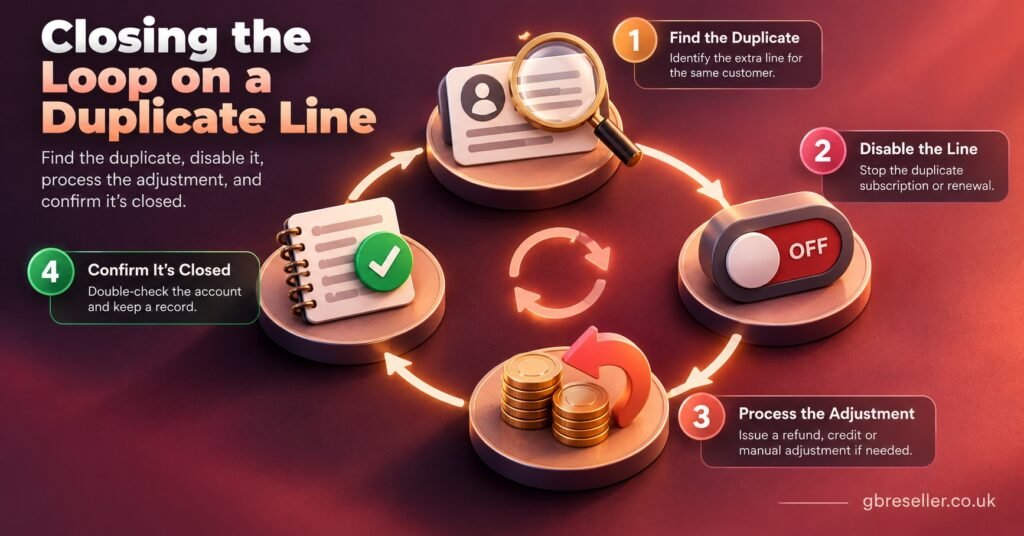
The sequence below is deliberately cautious. Deleting first and asking questions later is the single most common way a duplicate turns into a lost customer.
Find the pair
Search your reseller dashboard and your own records by more than one field. Usernames are often generated by the panel, so they rarely match. Phone numbers, email addresses, notes fields and creation dates are more reliable. If your team follows consistent IPTV reseller panel account naming conventions, this step takes seconds; if not, it is worth fixing that alongside the duplicate.
Confirm it is one customer
Matching details suggest a duplicate; they do not prove one. Check the address, the payment record and who created each line. Where there is any doubt, a short message to the customer asking which devices they use and whether they meant to have two subscriptions settles it.
Pick the survivor
Keep the line the customer’s devices are connected to now, if your panel shows connection activity. Reconfiguring apps on a television, a set-top box and two phones is the part customers resent, so the line that avoids that work is usually the right one to keep. Where both lines are in use, keep the one with the longer paid period and move the devices once, not twice.
Freeze the extra line
Disable or suspend the duplicate rather than deleting it. A disabled line can be switched back on in moments if you picked wrongly; a deleted one generally cannot be restored, and its history goes with it. Leave it frozen for a few days so that any device still quietly using it surfaces as a support message instead of a silent failure.
Settle the credits
This is where provider policy decides the outcome, and it varies. Some suppliers will return credits for a line that was created in error and never connected, particularly if you ask promptly; others treat every activation as final. Ask before assuming either way. If the credits cannot come back and the duplicate was never used, check whether your panel allows you to edit its credentials, because an untouched line can sometimes be reassigned to the next genuine new customer instead of being written off. Remaining time on a used duplicate generally cannot be merged into the survivor, so if the customer is owed that time, you will need to extend the survivor using your own credits.
Pro tip: Record the credit outcome for every duplicate you resolve. After a few months, that log shows exactly what your workflow gaps are costing you, which makes the case for fixing them far easier.
Tell the customer once
Send one clear message: which login to keep, which devices need updating, and when the old one stops working. Avoid sending fragments over several hours. If you are refunding money because they paid twice, say so in the same message.
Close the record
Update your spreadsheet or CRM so the duplicate is marked as closed and linked to the surviving line, with the date and the reason. Under UK data protection law, personal data should be accurate and kept no longer than necessary, as set out in the ICO’s guide to the data protection principles, so a stale duplicate entry holding someone’s phone number and email should not be left lying about indefinitely. Our guide to keeping IPTV reseller panel subscriber records covers which fields are worth holding and for how long.
A Worked Example From a Small UK Reseller
The following scenario is illustrative, built to show the decisions rather than to describe any real business.
A reseller in the Midlands runs around eighty lines with one part-time assistant. A customer, call her Anna, started on a one-month line (Line A) that expires mid-November. Early in the month she pays for twelve months over WhatsApp. The assistant, working from a phone, creates a new twelve-month line (Line B) and sends Anna fresh credentials. Anna never installs them because her existing login still works.
Two weeks later, Line A shows an expiry warning in Anna’s app. She emails the reseller asking to renew. The reseller, seeing only the email, extends Line A by twelve months. Anna now holds two twelve-month subscriptions, and the reseller has spent the credits for both.
Working through the order above, the reseller searches by Anna’s email and phone number and finds both lines. Payment records show a single twelve-month payment, so this is clearly an error rather than a second purchase. Line A has two devices connected; Line B has never connected. Line A survives. Line B is disabled the same day.
The reseller contacts their provider about Line B. Because it was never used, there is a reasonable case for the credit to be returned, but that is the provider’s decision. If the answer is no, the reseller can check whether Line B’s username and password can be edited and, if so, hold it for the next new customer. Anna receives a single message confirming that nothing changes on her side. The record for Line B is marked closed, linked to Line A, with a note explaining what happened.
The fix took perhaps twenty minutes. The prevention step that followed mattered more: the assistant now searches by phone number before creating any line, and renewals are only ever processed as extensions of an existing line.
Mistakes That Make Duplicates Worse
Deleting the wrong line is the obvious one, and it nearly always happens because someone assumed the newer line was the one in use. Connection activity, not creation date, is the guide.
Quietly leaving both lines active is the less obvious mistake. It feels harmless because the customer is happy, but you lose track of which line holds the real renewal date, renewal reminders may go out twice, and if the customer later shares the spare credentials with someone else, you now have an unpaid user on your account that is hard to trace.
Making a customer reconfigure every device when it could have been avoided is another. People forgive an administrative error far more readily than an evening spent re-entering logins on a television remote.
Finally, treating every duplicate as a credit write-off without asking the provider. You may be told no, but you will not get a credit back that you never request. Similarly, if a customer genuinely paid twice, deciding the outcome yourself without referring to your published terms invites disputes; a clear IPTV reseller cancellation policy gives you a consistent answer.
Keeping Duplicates Out at the Point of Creation
Prevention is mostly about where a line is created and who is allowed to create it. A few habits remove the bulk of the risk:
- Search by phone number and email before creating any new line, every time, including trials.
- Treat renewals strictly as extensions of the existing line, never as a new account.
- Convert trials by extending them where your panel allows, rather than issuing new paid credentials.
- Route all paid requests into one queue so WhatsApp, email and website orders are handled in one place.
- Agree in writing with sub-resellers what happens when a customer moves between them.
- Put the customer’s reference, not just their name, into the line’s notes field.
- Review recently created lines weekly for matching contact details.
None of this needs special software. A shared spreadsheet and a short routine are enough for most UK IPTV reseller operations up to a few hundred lines, and a well-run credit-based UK IPTV reseller panel does the rest.
FAQs
Can I merge two subscriber lines into one?
Most panels do not offer a true merge. You keep one line and close the other. If the customer is owed remaining time from the closed line, you would normally extend the survivor using your own credits.
Will my provider refund credits for a duplicate line?
It depends entirely on the provider. A line created in error and never connected has the strongest case, especially if raised quickly. Ask rather than assume.
What if the customer insists on keeping both lines?
Then it is no longer a duplicate. Make sure both are paid for, label them clearly, and check whether extra connections on one line would serve them better.
How do I spot duplicates created by my sub-resellers?
You usually cannot see them directly from your own view. Ask sub-resellers to share contact details for new lines, or compare exported lists periodically.
Should I keep a record of resolved duplicates?
Yes, but briefly. Note which line was closed, why, and what happened to the credits, then remove any personal details you no longer need.
Is sharing one line between two customers a fix for duplicates?
No. It breaches most provider terms, complicates support and removes your ability to manage each customer separately. Resell only services you are authorised to supply, with one paid line per customer.
Where This Leaves Your Panel
To Handle Duplicate IPTV Subscriber Accounts well, think in terms of survivors and evidence: find the pair, prove it is one customer, keep the line their devices use, freeze rather than delete, and ask before writing off credits. Whether those credits come back is outside your control, but how often duplicates appear is very much within it. Pick one prevention habit from the list above, apply it to your next ten new lines, and the problem shrinks quickly.