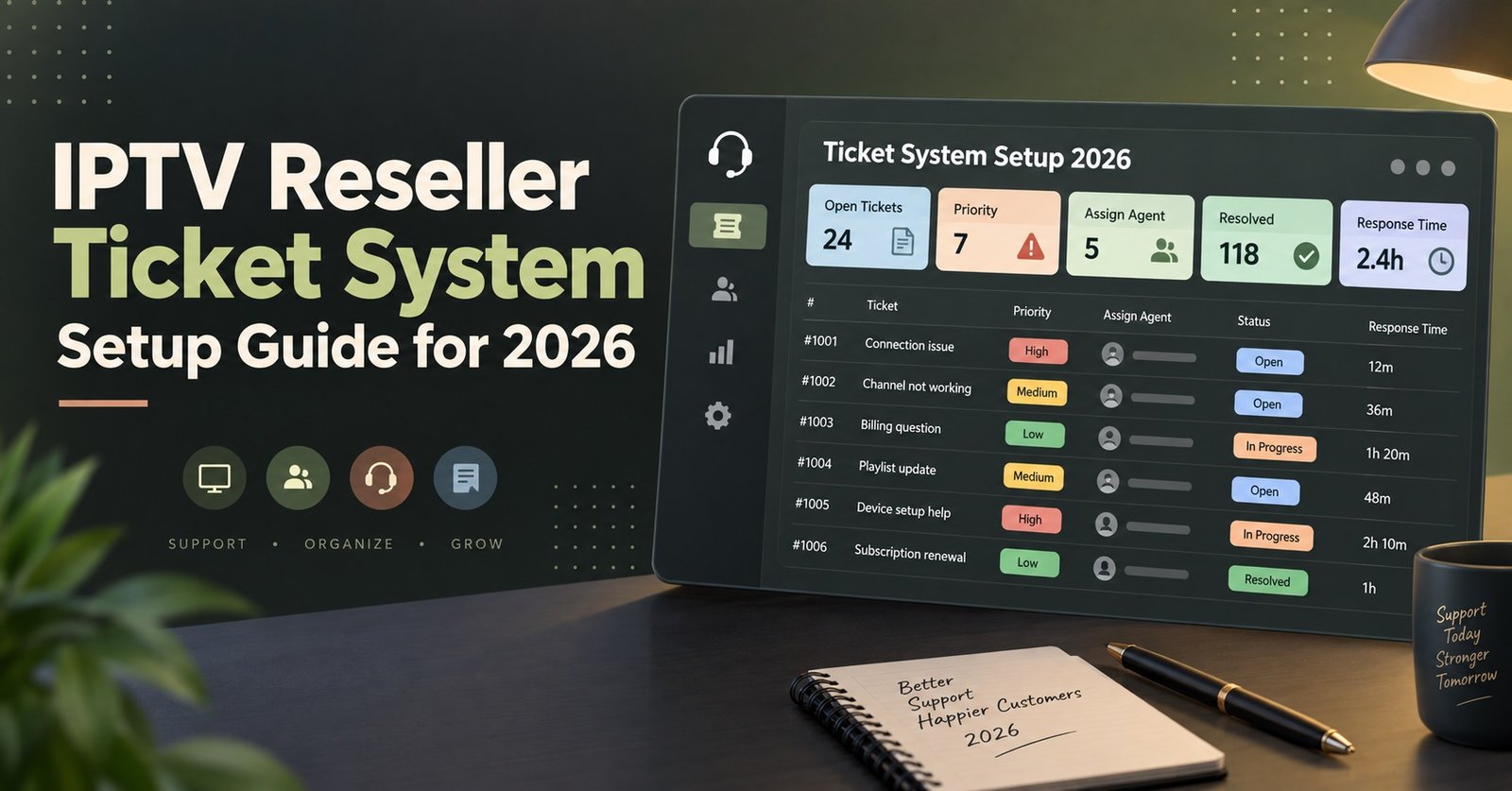

An IPTV Reseller Ticket System is the method you use to log every subscriber request, sort it by who can actually resolve it, and keep one named owner on it until it closes. It does not have to be software. A shared inbox with two labels and a written rule about who picks up what will outperform an expensive help desk that nobody has agreed how to use.
Where most IPTV panel reselling operations come unstuck is triage, not tooling. Every message arrives looking equally urgent because the subscriber writing it is equally annoyed, so a frozen app on one device gets the same panic response as a full line outage affecting forty accounts. Sorting by who can fix the problem, before sorting by how loudly it was reported, is the single change that makes the rest of the system hold together.
The Two Jobs Every Ticket Has to Pass Through
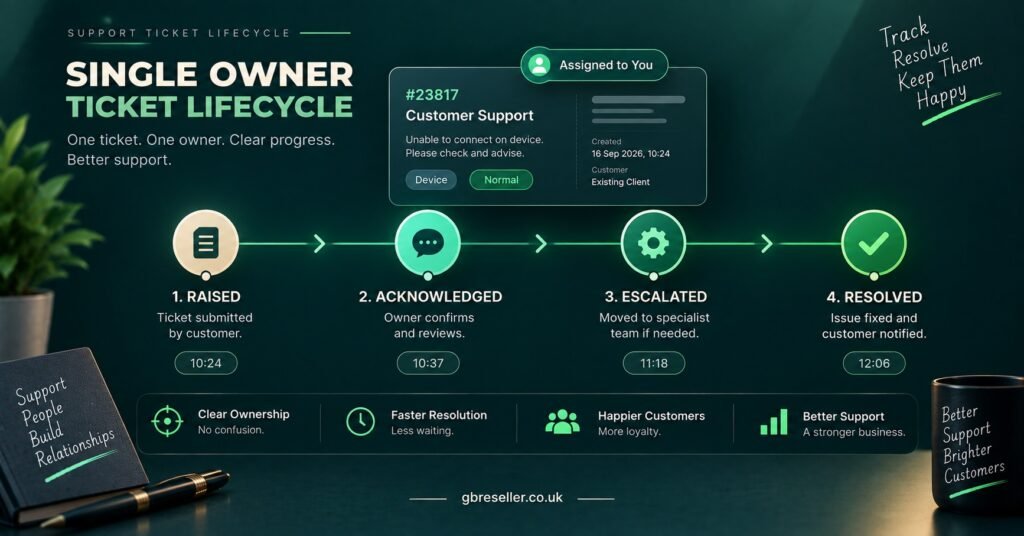
A ticket only needs to answer two questions before anyone starts typing a reply. Which category of problem is this, and whose name is on it until it is done.
Category tells you the realistic route to a fix. Ownership stops the request drifting between people, or worse, sitting untouched because everyone assumed someone else had picked it up. Operations with two or three people handling messages lose more tickets to that second failure than to any technical fault. A subscriber rarely leaves because a fix took six hours. They leave because nobody replied for six hours and then asked them to explain the problem again.
Both jobs happen before troubleshooting starts, and both take seconds once you have a rule to follow.
Sorting Tickets by Who Can Actually Fix Them
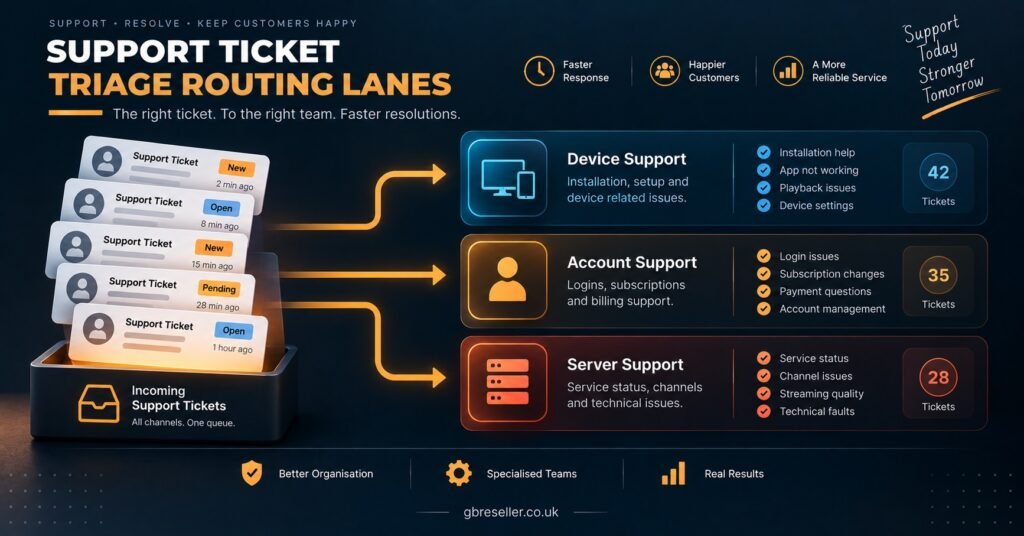
Almost every request a reseller receives falls into one of three buckets, and the bucket decides the first move rather than the eventual solution.
| Ticket type | Who can actually resolve it | First move |
|---|---|---|
| Device or app side, single subscriber affected | The subscriber, with your guidance | Send the matching setup steps, confirm device and app version |
| Account or billing side | You, inside the reseller dashboard | Check line status, expiry, and connection count before replying |
| Panel or upstream side, several subscribers affected | Your provider | Confirm the pattern across accounts, then escalate with evidence |
The third row is the one worth reading twice. If two unrelated subscribers report the same fault inside the same hour, you are no longer troubleshooting a device. Treating it as one is how resellers spend an evening walking individuals through reinstalls while the real cause sits upstream and untouched.
Pro tip: Before replying to any playback complaint, check whether a second subscriber has reported something similar that day. One question answered internally saves an hour of pointless device diagnostics.
Priority Levels That Actually Change Behaviour
Three levels are enough for almost any IPTV reseller operation, and adding more usually means nothing gets classified honestly.
Treat anything affecting multiple active lines as top priority, since it is either an upstream fault or something you have configured wrongly, and both get worse while unattended. Treat a single subscriber who cannot watch anything at all as second, because their service is fully down even though the scale is small. Treat everything else, meaning single channel complaints, quality questions, feature requests, and general how-do-I messages, as routine.
The discipline sits in the last group. Routine tickets still need a reply within a sensible window, but they do not justify dropping a live outage to answer them. Written levels make that decision for you at ten in the evening when judgement is thin.
One Name on Every Ticket, Including Yours
Ownership means a specific person is answerable for a ticket reaching a conclusion, not that they personally perform every step of the fix.
If you work alone, this sounds redundant until you count how many conversations you are holding at once across different channels. The owner rule then becomes a note to yourself: this one is mine and unfinished. Once a second person joins, whether a partner, a part time assistant, or a family member covering evenings, the rule stops being administrative and starts preventing duplicate replies, contradictory instructions, and the awkward moment when two people tell a subscriber two different things.
Handovers deserve a small ritual. A ticket changes hands only when the new owner has acknowledged it, and the handover note says what was already tried. Silent handovers, where someone assumes a colleague saw the message, are the most common cause of a request quietly dying. Pairing ticket ownership with clean subscriber records in your reseller CRM setup removes most of the guesswork, because whoever takes over can see the account history without asking the subscriber to repeat it.
When a Ticket Leaves Your Hands but Not Your Responsibility
Escalating to your provider does not transfer ownership. It transfers the work.
This distinction matters commercially. From the subscriber’s point of view they bought from you, so silence while you wait upstream reads as you ignoring them. The workable pattern is to keep the ticket open on your side, tell the subscriber plainly that the issue has been raised with the platform side and roughly when you will update them, then chase your provider rather than waiting for a notification that may never arrive.
Escalations also travel better with evidence attached. The account username, the approximate time the fault started, the device type, the number of other accounts showing the same symptom, and whether it affects live content, catch up, or the full library. Providers who handle many resellers at once respond faster to a report that can be reproduced than to a message saying it is not working.
Sub-reseller layers complicate this further. If a sub-reseller’s customer raises a problem, the sub-reseller owns the customer relationship and you own the escalation path above them. Blurring that, by replying directly to their customer, undermines the sub-reseller and leaves nobody sure who is chasing what.
Setting Up an IPTV Reseller Ticket System Without Buying Software
Most UK IPTV panel resellers start on messaging apps because that is where subscribers already are, and there is nothing wrong with that provided the messages become tickets rather than staying as conversations.
The minimum viable version is a simple log with six columns: date raised, subscriber identifier, category, priority, owner, and status. A spreadsheet handles this fine at small volume. What it gives you is not automation but visibility, because at a glance you can see what is open, what is waiting on someone else, and what has been sitting untouched for two days.
Move to a proper help desk tool when one of three things becomes true. More than one person answers messages regularly, subscribers start contacting you across several channels so context gets split, or you are losing track of open items rather than just handling them slowly. Buying a tool earlier than that adds admin without removing work.
Whatever the format, a strong ticket system is only half the load reduction. The other half comes from stopping tickets being raised at all, which is where a well-organised reseller knowledge base and automated renewal reminders before expiry do more good than any routing rule. Setup questions and billing confusion make up a large share of routine tickets in most operations, and both are largely preventable.
What to Capture at Intake So You Only Ask Once
Back and forth is the hidden cost of an unstructured system. Four details, gathered in the first reply, resolve or route the majority of playback complaints.
Ask which device and app they are using, whether the problem affects everything or only certain content, when it started, and whether anyone else in the household is watching at the same time. That last one quietly explains a large share of sudden playback failures, since connection limits are exceeded more often than subscribers realise, particularly when an old device has been left signed in.
Save those questions as a short reusable block. It is not impersonal if the rest of your reply is written normally, and it removes two or three message exchanges from every technical ticket.
Pro tip: Record the resolution in one short line when you close a ticket, not just the fact that it closed. Three months later, that line is the fastest reference you will have for a repeat fault on the same device type.
Signs the System Has Quietly Stopped Working
Ticket systems rarely collapse. They erode, and the symptoms are recognisable.
Open items stay open with no recent note, which usually means ownership was never assigned rather than that the problem is hard. Subscribers chase for updates more often than they raise new issues, suggesting your update rhythm is slower than their patience. The same fault appears repeatedly under different subscriber names without anyone connecting them, which points to weak categorisation rather than bad luck. And messages arrive on a channel nobody formally checks, such as a rarely used email address on your site, so they age untouched.
None of these require rebuilding anything. They usually mean tightening one rule, most often the ownership rule.
Frequently Asked Questions
Do WhatsApp messages count as tickets, or do they need to be logged separately?
They count once they are logged. The message thread is where the conversation happens, but a request that exists only inside a chat window has no owner, no status, and no way of being noticed when it goes quiet.
Who owns a ticket while it is sitting with the provider?
You do. The provider owns the fix, you own the subscriber relationship and the update schedule. Closing a ticket because it has been escalated leaves the subscriber with nobody tracking their problem.
How many priority levels should a small reseller use?
Three is usually the practical limit. Five levels sound more precise but tend to collapse into everything being marked as high, which removes the benefit entirely.
What happens when a sub-reseller’s customer raises a problem?
The sub-reseller handles their own customer and raises a ticket with you only if the issue needs panel level access or upstream escalation. Answering their customer directly damages the sub-reseller’s position and blurs who is responsible next time.
Should subscribers receive a ticket reference number?
Only if your volume genuinely needs it. At small scale a reference number adds formality without adding clarity, and most subscribers respond better to a named person confirming they are dealing with it.
Where to Start If You Have Nothing in Place Yet
Building an IPTV Reseller Panel Ticket System is less about choosing a platform and more about agreeing two rules and sticking to them: sort by who can fix the problem, and put one name on every open item. Those two rules alone will cut your response times before you spend anything.
Start by logging every request for a fortnight, however roughly, and categorising each one into device side, account side, or upstream. The distribution will tell you where your actual pressure is, and that should decide what you fix next, whether that is better setup documentation, tighter renewal handling, or a firmer escalation routine with your provider. It is also worth being realistic about limits, since some faults sit entirely with the platform layer and no amount of internal process will shorten them. What a good system does is make sure the subscriber never feels forgotten while you wait, and that is usually what they remember.