
How to Price Your IPTV Reseller Subscriptions for Maximum Profit
A reseller messaged me last winter, furious. He’d sold 400 connections in three months and somehow ended the quarter with less cash than he started. His pricing looked fine on paper — until you counted the refunds, the credit he burned on dead trials, and the two clients who chargebacked him into oblivion. Volume was never his problem. Math was.
This is the quiet truth about IPTV UK reseller subscriptions: most people who fail aren’t bad at selling. They’re bad at pricing. They copy whatever the panel above them charges, shave a pound off to “stay competitive,” and never notice the margin bleeding out through the cracks. If you’ve been treating your price as a number you guess rather than a number you engineer, the next few thousand words are going to sting a little — and then save you money.
Your Cost Isn’t What You Think It Is
Ask a new reseller what a single subscription costs them and they’ll quote the credit price. One credit, one year, say £3. Clean. Simple. Completely wrong.
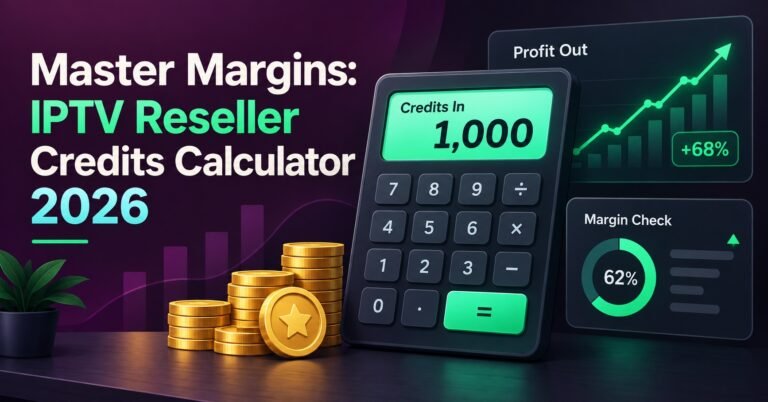
Your real cost per active subscriber includes the credits you waste on trials that never convert, the time you spend on support, the refunds you eat, and the dead accounts you carry while a customer “thinks about it.” When we audited the books of a mid-sized UK reseller, the headline cost was £3.10 per line. The actual fully-loaded cost — once we folded in trial wastage and support churn — was closer to £5.40. He was selling at £8 and convinced he was banking £5 a head. He was banking £2.60.
Here’s the breakdown that changed how he priced everything:
| Cost component | Per subscriber | Often ignored? |
|---|---|---|
| Panel credit | £3.10 | No |
| Trial wastage (failed conversions) | £0.90 | Yes |
| Support time (avg per line) | £0.70 | Yes |
| Refunds & chargebacks (spread) | £0.50 | Yes |
| Replacement/migration cost | £0.20 | Yes |
| True cost | £5.40 | — |
Until you know your fully-loaded number, every price you set is a guess wearing a suit.
Why Cheap Pricing Attracts Your Worst Customers
There’s a counterintuitive lesson that takes most operators years to learn: the cheaper you price, the worse your customers behave.
After reviewing hundreds of support requests across multiple panels, a pattern was impossible to ignore. The clients paying £5 a year generated nearly four times the support tickets of clients paying £12. They demanded more, tolerated less, and churned the instant a competitor undercut them by fifty pence. They weren’t loyal to you. They were loyal to the lowest number on the screen.
Pro Tip: Price is a filter before it’s a revenue lever. A slightly higher price doesn’t just earn more per sale — it screens out the chronic complainers and chargeback artists who quietly destroy your margins. Cheap subscriptions don’t attract customers; they attract liabilities.
When you set your IPTV reseller subscriptions too low, you’re not winning the market. You’re inheriting everyone else’s problem clients — the ones the disciplined resellers already priced away.
The Margin Math Nobody Teaches You
Profit in this business lives in a number most resellers never calculate: contribution margin after churn.
It works like this. Take your selling price, subtract your true fully-loaded cost, then multiply by the percentage of customers who actually stay long enough to be worth acquiring. A line sold at £8 with a £5.40 cost looks like a £2.60 win — but if 30% of those customers vanish before renewal and you’ve already spent on acquiring them, your real per-customer profit drops sharply.
Consider two resellers side by side:
| Metric | Reseller A (cheap) | Reseller B (priced right) |
|---|---|---|
| Price | £5 | £10 |
| True cost | £5.40 | £5.40 |
| Margin per line | −£0.40 | £4.60 |
| Annual churn | 45% | 18% |
| Net per retained customer | Negative | Strong |
Reseller A is paying for the privilege of having customers. He feels busy. He feels successful. He’s quietly going broke. Reseller B sells fewer lines, sleeps better, and keeps more.
Tiering: The Lever Most Resellers Leave Untouched
Flat pricing is lazy pricing. One price for everyone means you overcharge the casual buyer and undercharge the heavy user who’d happily pay more.
A tier structure does the segmentation for you. Here’s a framework that has worked repeatedly for UK-focused operators selling IPTV reseller subscriptions:
- Entry tier — single connection, annual billing only. Priced to be accessible but never the cheapest in the room. This is your filter, not your loss leader.
- Standard tier — single connection plus priority support and a faster replacement guarantee. Most customers land here, and it’s where your healthiest margin lives.
- Multi-connection tier — two to four lines for families and shared households. Higher absolute price, better value per line, dramatically lower churn because switching costs rise with every connected device.
- Reseller/sub-reseller tier — credit packs for people building their own downstream. Lower per-unit price, far higher volume, near-zero support burden.
The mistake we repeatedly see is resellers building only the entry tier and wondering why nobody spends more. People will climb a ladder if you build one. No ladder, no climb.
How Billing Cycle Quietly Controls Your Cash Flow
Monthly billing feels customer-friendly. It’s also a churn machine.
Every monthly renewal is a fresh decision point — a moment where the customer can leave, forget to pay, or get poached. Annual billing eliminates eleven of those decision points a year. During one migration project, a reseller switched his default offer from monthly to annual-with-discount and watched his churn fall by nearly half within two cycles. He earned slightly less per month on paper and far more per customer over the relationship.
Pro Tip: Anchor on annual, offer monthly only as a premium-priced fallback. When monthly costs proportionally more than annual, customers talk themselves into the longer commitment — and you lock in cash flow while slashing churn. Never let monthly be the cheaper-feeling option.
The math is simple and the discipline is hard: cash you collect today is worth more than cash you hope to collect across twelve fragile renewals.
Pricing Psychology That Actually Moves Decisions
People don’t evaluate price in a vacuum. They evaluate it against whatever number you show them first.
This is why a three-tier menu nearly always outsells a single price. The expensive tier makes the middle tier feel reasonable; the cheap tier makes the middle tier feel like the smart choice. Most buyers reach for the middle — so design your middle tier to be the one you most want to sell.
A few field-tested moves:
- Show annual savings in pounds, not percentages. “Save £24 a year” lands harder than “save 20%.”
- End prices on a confident number. Round, clean pricing signals a stable operation. Endless .99 endings can read as bargain-bin in a market already fighting a credibility problem.
- Never lead with your cheapest option. Whatever you show first becomes the anchor everything else is measured against.
One reseller lost months of potential revenue simply because his pricing page listed the cheapest plan at the top. Visitors anchored low, and every other tier looked expensive by comparison. Reordering the page — premium first — lifted his average order value without changing a single price.
What Happens When Your Service Quality Doesn’t Match Your Price
Pricing higher only works if the experience justifies it — and this is where infrastructure quietly decides your pricing ceiling.
You cannot charge premium prices on a panel that buffers during every big match. During a major sports event last season, the resellers who’d cut corners on backup uplinks and load balancing got buried in tickets, refund demands, and angry reviews — right when acquisition was at its peak. The ones running redundant routing and failover barely noticed the traffic spike. Same weekend, opposite outcomes.
Pro Tip: Your maximum sustainable price is capped by your weakest infrastructure moment, not your average one. Customers forgive a smooth Tuesday; they cancel over a frozen cup final. Price for the experience you can deliver under load, not the one you deliver on a quiet night.
This is the link most pricing guides miss entirely. Margin and uptime are the same conversation. If you want to charge more, you have to be worth more when it counts — and that means partnering with a supplier whose backbone holds during peak demand. Sourcing from a stable, well-provisioned upstream like a established UK IPTV reseller infrastructure isn’t a cost to minimize; it’s the thing that lets you defend a higher price at all.
Reading Your Own Numbers Before You Reprice
Most resellers reprice on feeling. Better operators reprice on signals.
Before you change a single figure, pull these from your panel and support logs:
- Renewal rate by tier — which prices keep customers and which leak them.
- Ticket volume per pound earned — the truest measure of which customers are actually profitable.
- Trial-to-paid conversion — if it’s collapsing, your problem may be onboarding, not price.
- Average revenue per active line — the number that tells you whether tiering is working.
We noticed unusual patterns when a reseller finally segmented his churn by price band: nearly all his cancellations clustered in the bottom tier, while his mid and family tiers were rock solid. He didn’t have a pricing problem. He had a cheap-tier problem. He killed the bottom tier entirely, and his overall numbers improved the same month.
Data turns repricing from a gamble into a decision.
Common Pricing Mistakes That Drain Reseller Profit
A quick field catalogue of the errors that show up again and again across IPTV reseller subscriptions:
- Pricing against the cheapest competitor instead of your own costs.
- Forgetting trial wastage and support time when calculating margin.
- Offering monthly billing at a price that makes annual pointless.
- Building one flat tier and leaving upgrade revenue on the table.
- Discounting to win a price-sensitive customer who’ll churn anyway.
- Repricing on instinct without reading renewal and ticket data first.
- Charging premium prices on infrastructure that can’t survive a peak.
None of these are exotic. Every one of them is quietly common — and every one is fixable the moment you treat price as something you build rather than something you copy.
Frequently Asked Questions
How much should I charge for IPTV reseller subscriptions in the UK?
There’s no universal figure, but price from your fully-loaded cost upward, not from your competitor downward. Once you account for trial wastage, support, and churn, most sustainable UK pricing for IPTV reseller subscriptions sits well above the cheapest panels advertise. Aim for a margin that survives an 18–20% churn rate comfortably.
Why are my cheap subscriptions less profitable than expensive ones?
Because price filters behavior. Lower-priced customers generate disproportionately more support tickets, churn faster, and chargeback more often. The revenue per sale is smaller and the cost to serve is larger, so cheap lines frequently lose money once you fold in support time and refunds. Higher prices screen out your most expensive customers.
Should I offer monthly or annual billing?
Anchor on annual. Each monthly renewal is a chance for a customer to leave, forget, or get poached, so annual billing dramatically reduces churn and stabilises cash flow. Offer monthly only as a higher-priced fallback so the annual plan always feels like the smarter financial choice.
How do I price reseller and sub-reseller credit packs?
Price packs on volume logic, not flat margin. Sub-resellers buy in bulk and generate almost no direct support load, so a lower per-unit price still yields strong total profit. Build tiered pack sizes that reward larger commitments while protecting enough margin to keep your own infrastructure well provisioned.
Does service quality actually affect how much I can charge?
Directly. Your maximum sustainable price is capped by your worst performance under load, not your average uptime. Customers tolerate minor issues on quiet days but cancel over failures during major events. Premium pricing requires premium reliability — redundant uplinks, load balancing, and failover are pricing tools, not just technical ones.
How often should I review my pricing?
Review at least quarterly, and always after a major event or a panel cost change. Pull renewal rates by tier, ticket volume per pound earned, and trial conversion before adjusting anything. Reprice on data, not feeling — and change one variable at a time so you can actually read what worked.
Will raising my prices cost me customers?
You’ll likely lose some — and they’ll usually be the least profitable ones. A modest, well-communicated increase typically improves total profit because the customers who leave over fifty pence were rarely worth keeping. Pair any rise with a visible reliability or support improvement so the value story stays intact.
Your Pricing Execution Checklist
For subscribers evaluating a service:
Compare reliability during peak events, not just headline price. Ask whether the provider runs backup routing. Choose annual only once you’ve tested stability. Treat a suspiciously cheap price as a warning, not a win.
For resellers:
Calculate your fully-loaded cost per line before setting any price. Build at least three tiers with a deliberate middle. Anchor billing on annual and price monthly as a premium. Pull renewal and ticket data quarterly before repricing. Kill any tier whose churn and support load make it unprofitable. Invest in infrastructure that lets you defend a higher price.
For sub-resellers:
Know your upstream credit cost to the penny. Price packs on volume, not flat margin. Reward larger commitments with better per-unit pricing. Avoid undercutting yourself into the lowest, most volatile end of the market.
Pricing IPTV reseller subscriptions well isn’t about finding one magic number — it’s about understanding your true costs, filtering for better customers, anchoring on annual commitments, and never charging more than your infrastructure can honestly support. Get those four right and the profit takes care of itself. That’s the end of this guide — now go reprice with numbers instead of nerves.