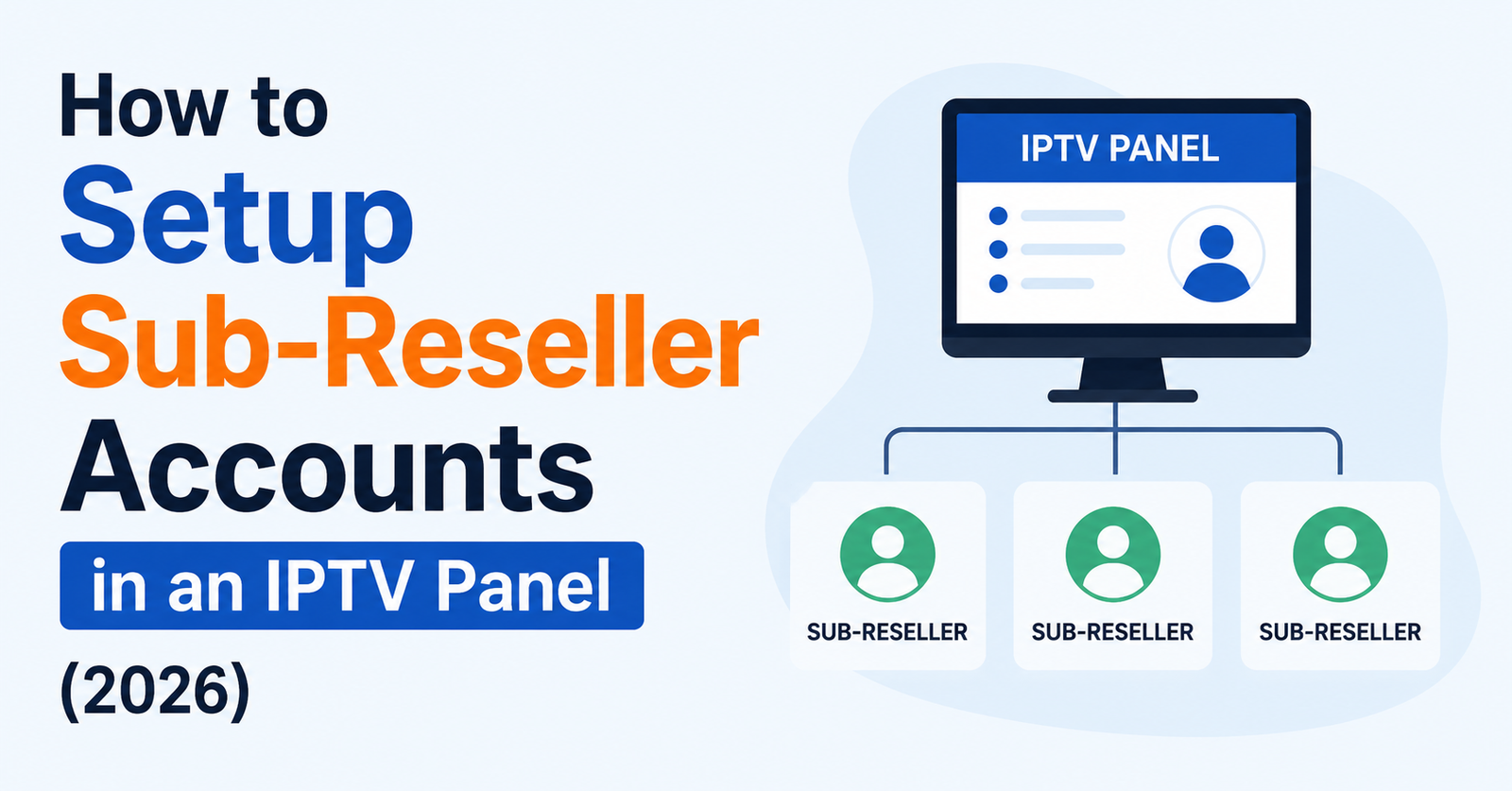

If you already run an IPTV reseller panel and want other people selling under you, learning how to setup sub-reseller accounts comes down to three things: creating a separate login inside your dashboard, giving that login a fixed credit allowance rather than unlimited access, and restricting what it can see or change. Most reseller panels, including the one gbreseller.co.uk operates, let you do this from the same dashboard you already use for subscriber lines. The setup itself usually takes a few minutes. The part that actually matters is deciding how much control to hand over before you create the account, because that decision is far harder to reverse than the setup itself.
What a Sub-Reseller Account Actually Is
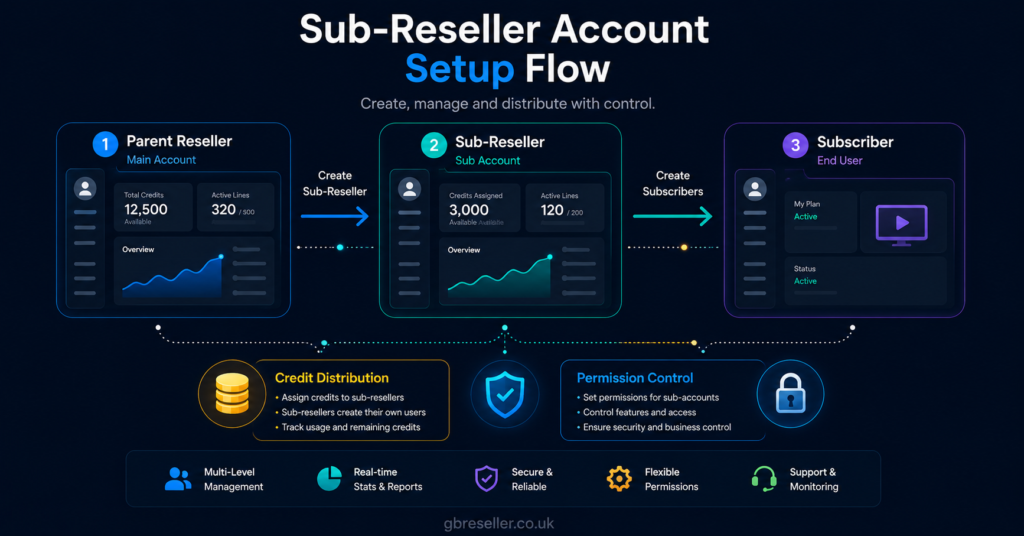
A sub-reseller account is a second layer of access sitting underneath your main reseller panel. Instead of you personally creating every subscriber line, a sub-reseller logs into their own restricted dashboard, draws from a credit balance you control, and creates lines for their own customers. You stay the parent account. They operate underneath you, usually with a smaller set of permissions than you have.
This is different from simply sharing your login with a friend or employee. A proper sub-reseller account has its own credentials, its own credit ledger, and its own activity log, so you can see exactly what has been created, when, and by whom. If a panel does not offer this separation and instead just gives someone a copy of your password, that is not a sub-reseller setup, it is a shared account, and it removes any ability to track who did what.
Why Panel Owners Create Sub-Reseller Layers
The usual reason is growth without extra admin work. Once you are managing more subscribers than you can comfortably support alone, handing a portion of the customer base to a sub-reseller lets you scale without hiring staff directly. The sub-reseller earns a margin on what they sell, you earn a margin on the credits they buy from you, and your own workload for those accounts drops close to zero.
It also spreads geographic or niche coverage. A sub-reseller who already has a local customer base, a WhatsApp following, or a specific community they sell into can bring in subscribers you would never reach on your own. You are effectively renting out part of your infrastructure and support relationship in exchange for a cut of every credit they use.
Before You Create the Account: Decide What You Are Actually Giving Away
This is the step most panel owners skip, and it is the one that causes the most regret later. Before you touch the dashboard, decide on paper what the sub-reseller will be allowed to do. At minimum, work out:
- How many credits they start with, and whether you will top them up manually or let them buy more themselves
- Whether they can see your other customers or only the ones they personally create
- Whether they can change channel packages, extend trial periods, or issue refunds
- What happens to their existing customers if you end the arrangement
Panels vary in how granular these controls are. Some let you tick individual permissions one by one. Others only offer a fixed “sub-reseller” role with permissions bundled together. Check which type your panel uses before promising a sub-reseller more flexibility than the system can actually deliver.
Step-by-Step: Setting Up the Account in Your Dashboard
The exact menu names differ between panels, but the sequence is broadly the same across most Xtream Codes-based systems, including the reseller dashboards described on GB Reseller Panels’ guide to how IPTV Panel reseller dashboards work.
- Log into your main reseller dashboard and find the section usually labelled Resellers, Sub-Resellers, or User Management.
- Create a new user and select the sub-reseller role rather than the subscriber role. This is the step most likely to be missed by someone new to panel administration.
- Assign a starting credit balance. Start smaller than you think you need. It is easy to add more credits later and far harder to claw back trust if a large balance disappears through a billing dispute or a compromised login.
- Set permission limits, restricting access to billing settings, package pricing, or any area you do not want touched.
- Generate login credentials and send them through a private channel, not a shared group chat.
- Test the account yourself, or ask the sub-reseller to create one dummy line, so you can confirm the credit deduction and activity log are behaving as expected.
Credit Control: The Part Most Owners Get Wrong
Credits are the currency of the relationship, and how you manage them determines whether a sub-reseller arrangement is profitable or a constant source of disputes. Most panels support either manual top-ups, where you personally add credits after receiving payment, or automated top-ups tied to a payment method on file. Manual top-ups give you more control but more admin work. Automated top-ups save time but require trust in the payment process.
Whichever method you choose, keep a habit of checking the credit ledger regularly rather than only when something goes wrong. A sudden spike in credit usage is often the first sign of either fast legitimate growth or a shared login being used by more people than agreed.
| Credit Approach | Best For | Limitation |
|---|---|---|
| Manual top-up | New or unproven sub-resellers | Slower for the sub-reseller, more admin for you |
| Automated top-up | Established sub-resellers with steady volume | Requires trust in payment handling |
| Fixed monthly allowance | Predictable small-scale arrangements | Does not flex with genuine demand spikes |
Pro tip: Set a maximum single top-up amount on new sub-reseller accounts for the first month, even if your panel allows unlimited top-ups, so an unexpected spike does not drain a shared server slot before you notice it.
Permissions: What to Restrict and Why
New panel owners often either lock a sub-reseller down so tightly that the account is barely usable, or open everything up because it feels simpler. Neither works well long term. A sensible middle ground usually restricts access to your master billing details, your own upstream credit source, and the ability to create additional sub-reseller layers underneath the one you just created.
What you generally want a sub-reseller to retain is the ability to create and manage their own subscriber lines, view their own credit balance, and see basic status information for the lines they created. Anything beyond that should be a deliberate decision rather than a default setting.
Sub-Reseller Versus Direct Reseller: Where the Differences Matter
| Factor | Direct Reseller | Sub-Reseller |
|---|---|---|
| Credit source | Buys directly from the panel provider | Buys from the parent reseller |
| Pricing control | Sets prices independently | Often follows guidance from the parent |
| Support responsibility | Handles their own customer support | May rely partly on the parent for escalations |
| Account risk | Tied to the provider relationship | Tied to both the provider and the parent reseller |
This distinction matters most when something goes wrong. If a provider suspends a panel, every sub-reseller underneath it loses access too, even though they had no direct relationship with the provider. Anyone considering becoming a sub-reseller should understand that their business sits on top of someone else’s arrangement, not their own.
Supporting Sub-Resellers Without Becoming Their Helpdesk
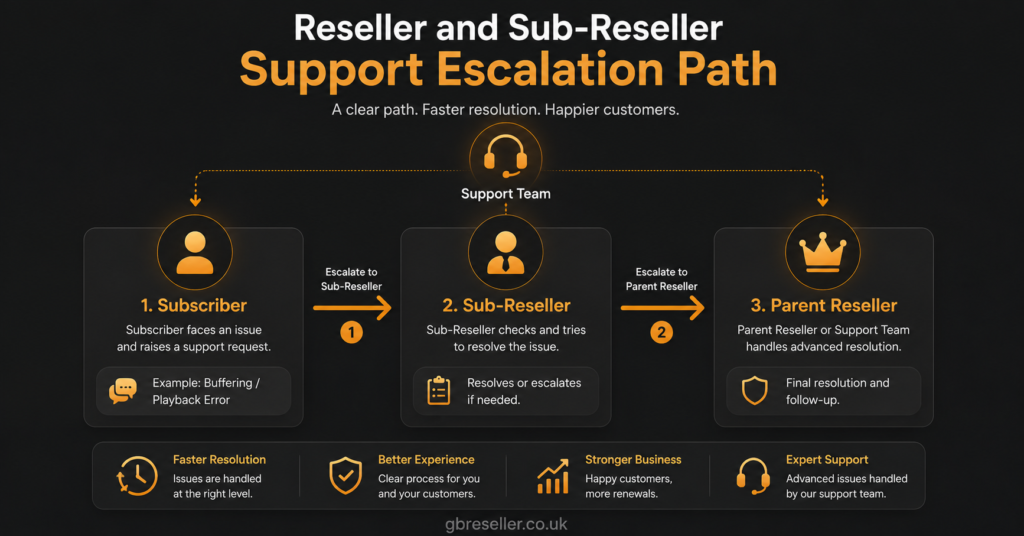
Once the account exists, ongoing management is where most of the real work happens. Give sub-resellers clear documentation on common subscriber issues, such as buffering checks or device setup steps, so they are not forwarding every basic question to you. A simple shared guide, even a short document, reduces the number of messages you receive dramatically.
Set expectations early about escalation. Decide what counts as something the sub-reseller should handle themselves versus what genuinely needs your involvement, such as a server-wide outage. Providers like britishseller.co.uk, used here only as an illustrative example of how a panel might structure this, typically expect the parent UK IPTV Panel reseller to filter routine questions before anything reaches upstream support.
Common Mistakes to Avoid
Handing over full billing access on day one is the most common early mistake, usually made because it feels like a gesture of trust rather than a business decision. A second common mistake is failing to document the arrangement, so when a dispute arises over pricing or credit balances there is nothing to refer back to. A third is not checking your own panel’s terms of service, since some providers restrict or explicitly forbid multi-tier reselling, and building a sub-reseller network on top of an account that prohibits it risks losing everything if discovered.
Legitimate Access and Content Rights
IPTV is a delivery technology, not a content licence. Whether a particular channel bundle is being distributed legitimately depends entirely on the underlying content rights and the agreements the provider holds, not on how professional the panel or website looks. Before building a sub-reseller structure on top of any provider, it is worth checking their business transparency, their terms of service, and how clearly they describe their content sourcing, rather than assuming a slick dashboard is proof of anything.
Reseller Guidance
Treat every sub-reseller account the way you would treat a small business partner, because that is effectively what it is. Keep credit limits sensible until trust is established, document pricing agreements in writing, and review activity logs on a regular schedule rather than only reactively.
Sub-Reseller Guidance
If you are the one being offered a sub-reseller account, ask who owns the ultimate provider relationship, what happens to your customers if that relationship ends, and how quickly the parent reseller responds to support requests. Your business is only as stable as the account sitting above yours.
Frequently Asked Questions
Do I need special software to setup sub-reseller accounts?
No separate software is usually required. Most reseller panels, including Xtream Codes-based systems, include sub-reseller or multi-tier user roles built into the same dashboard you already use.
How many credits should a new sub-reseller start with?
There is no fixed number that suits every situation. A smaller starting balance is generally safer while you assess how the sub-reseller manages billing and communicates with their customers.
Can a sub-reseller create their own sub-resellers?
Some panels support multiple tiers, but many restrict this by default. Check your specific panel’s permission settings rather than assuming multi-tier layering is available.
What happens to a sub-reseller’s customers if I close their account?
This depends entirely on how the arrangement was set up. If lines were created under a shared credit pool without clear ownership records, disputes over who those customers belong to become far harder to resolve.
Is a sub-reseller responsible for their own customer support?
Usually yes, for day-to-day issues. Escalations involving server-wide problems or provider-level outages typically still need to reach the parent reseller.
Does gbreseller.co.uk support sub-reseller account setup?
Panel providers vary in how they structure multi-tier access, so it is worth checking directly with any specific provider, including GB Reseller Panels’ pricing and package details, before assuming a feature is included.