

Forget everything you’ve read about launching an IPTV reseller business UK. Every guide out there reads like a copy-paste job — buy credits, set up a website, start selling. If that formula worked, every teenager with a PayPal account would be running a six-figure operation by now. They’re not. Most of them vanish within ninety days, buried under chargebacks, angry customers, and ISP blocks they never saw coming.
This isn’t that kind of article.
What you’re about to read comes from years of operating inside the UK IPTV reseller space — losing servers, rebuilding customer bases from scratch, dealing with payment processor freezes at the worst possible moment, and learning that the difference between a reseller who survives and one who disappears comes down to decisions made in the first thirty days.
The IPTV reseller business UK landscape in 2026 looks nothing like it did even two years ago. Entry barriers are higher. Enforcement is smarter. Customers are pickier. And the operators still standing? They treat this like infrastructure management, not a side hustle.
Let’s get into what actually matters.
The Three Forces That Kill an IPTV Reseller Business UK Before It Grows
Every failed IPTV UK reseller operation shares the same autopsy report. It wasn’t one catastrophic event. It was three slow-moving problems they refused to address until the damage was irreversible.
Chargebacks come first. A customer disputes a payment, your processor flags your account, and suddenly you’re scrambling to prove you delivered a service that — by its nature — doesn’t generate traditional receipts. Stack up enough of these disputes and your payment gateway shuts you down entirely. No gateway, no business.
ISP blocking comes second. In 2026, AI-driven deep packet inspection has moved beyond simple DNS poisoning. Major UK internet providers are now identifying IPTV traffic patterns at the protocol level. Your customers call you — not their ISP — when streams stop working. And if you can’t walk them through a VPN setup or DNS workaround within minutes, they’re gone.
Support overwhelm is the third killer. This is the one nobody talks about because it doesn’t sound dramatic. But when you’ve got 200 active subscribers pinging you on WhatsApp at 8pm on a Saturday because a server stuttered for forty-five seconds during a premium sports stream, you understand why most resellers burn out before they scale.
Pro Tip: Set up canned responses for your five most common support issues — buffering, EPG errors, VOD loading failures, login problems, and app installation. This alone cuts your response workload by roughly 60%.
Why Panel Credits Should Be Your First and Largest Investment
Here’s what separates experienced operators from newcomers trying to build an IPTV reseller business UK on enthusiasm alone: budget allocation.
A beginner walks in with £300 and immediately spends £80 on a logo, £50 on a domain, £40 on hosting, and £30 on social media ads. They’ve burned over half their budget before activating a single subscription.
An operator walks in with £300 and puts £250 directly into panel credits.
The logic is brutally simple. Panel credits are your inventory. Without them, you have nothing to sell. Everything else — branding, website polish, marketing — is cosmetic until you can actually fulfill orders and test the service you’re reselling.
| Budget Item | Beginner Allocation | Operator Allocation |
|---|---|---|
| Panel Credits | £80 (27%) | £250 (83%) |
| Branding/Logo | £80 (27%) | £0 (0%) |
| Domain + Hosting | £90 (30%) | £30 (10%) |
| Marketing | £50 (16%) | £20 (7%) |
That table isn’t theoretical. It’s the pattern that plays out across hundreds of new IPTV reseller business UK operations every quarter. The ones who front-load inventory survive long enough to earn reinvestment capital. The ones who front-load cosmetics run out of credits mid-month and can’t fulfill orders.
Pro Tip: Buy credits in bulk tiers where the per-credit cost drops significantly. Most panel providers offer price breaks at the 50-credit and 100-credit thresholds. The maths compounds fast over a calendar year.
The 30-Day Mistake That Costs More Than Any Server Crash
Ask any experienced IPTV reseller business UK operator what kills new entrants faster than downtime, and you’ll get the same answer: ignoring customer support.
It sounds obvious written down. It isn’t obvious at 11pm when you’ve got fifteen unread messages and a day job to wake up for. New resellers chase acquisition obsessively — posting in Facebook groups, running Telegram promotions, offering discount trials. They measure success by how many new subscribers they add per week.
Meanwhile, their existing customers are churning silently. No response to a buffering complaint means that customer asks for a refund — or worse, files a chargeback. No follow-up after a service disruption means that customer tells three friends the service is unreliable.
Here’s the calculation most newcomers never run:
- Acquiring a new IPTV subscriber costs roughly £2–£5 in marketing effort and time
- Retaining an existing subscriber costs approximately £0.10 in a two-minute WhatsApp reply
- A single chargeback costs £15–£25 in processor fees — plus the lost revenue
Retention isn’t just cheaper than acquisition. In the IPTV reseller business UK, it’s the only sustainable growth model. Your subscriber count doesn’t matter if your churn rate is eating your revenue every billing cycle.
The resellers who survive beyond ninety days build a support rhythm early. Dedicated hours. Template responses. A simple FAQ page on their storefront. Even an auto-reply confirming receipt of a message buys goodwill that translates directly into reduced churn.
ISP Blocking in 2026: What Changed and What You Actually Need to Know
The ISP blocking landscape facing every IPTV reseller business UK operation has shifted fundamentally. Two years ago, most blocking relied on DNS-level filtering. Change your DNS to a public resolver, and streams worked again. That era is functionally over for most major UK internet providers.
What’s replaced it is a layered enforcement approach:
- DNS poisoning still exists as the first filter — basic and easy to bypass, but it catches casual users who don’t know alternatives
- Deep packet inspection (DPI) now identifies HLS streaming patterns associated with IPTV traffic, even when DNS is bypassed
- AI-driven traffic classification is the 2026 addition — machine learning models trained to recognise IPTV usage patterns based on connection behaviour, packet timing, and server destinations
For your subscribers, this means a VPN is no longer optional — it’s a baseline requirement. And for you as a reseller, it means your support documentation needs to include VPN setup guides for every major device your customers use.
Pro Tip: Pre-install or pre-configure VPN settings on any APK or app you distribute to customers. The fewer steps between “I can’t watch” and “it’s working,” the fewer support tickets you handle and the fewer customers you lose.
The real infrastructure lesson here isn’t technical — it’s psychological. Your customers don’t care about DPI or DNS poisoning. They care that the screen went black. Your job is to make the fix invisible or, at minimum, painless. That’s what separates a functioning IPTV reseller business UK from a WhatsApp group full of complaints.
Backup Infrastructure: The Conversation Most Resellers Have Too Late
There’s a specific moment in every reseller’s career when they understand the value of redundancy. It’s usually a Saturday evening. A major sporting event is live. Their primary panel goes down. And three hundred subscribers start messaging simultaneously.
If you don’t have a backup panel pre-configured and ready to activate, that evening destroys your reputation in real time. Social proof in the IPTV reseller business UK space works in both directions — a good recommendation spreads slowly, but a bad experience during peak viewing gets screenshotted and shared in reseller groups within the hour.
Operating with backup uplink servers and a secondary panel isn’t a luxury. It’s the minimum viable infrastructure for any reseller handling more than fifty active lines.
Here’s what a functional failover looks like:
- Primary panel handles all day-to-day activations and renewals
- Secondary panel sits dormant with a small credit balance, pre-tested monthly
- When primary drops, you migrate active M3U or Xtream Codes credentials to the backup within minutes — not hours
- Customers experience a brief interruption, not a total blackout
The cost of maintaining a backup panel is negligible compared to the cost of a single peak-time outage. A few credits sitting idle on a secondary provider is insurance. Losing fifty subscribers because you had no Plan B is a business-level failure.
| Infrastructure Approach | Cheap Setup | Professional Setup |
|---|---|---|
| Panel Providers | 1 (no backup) | 2+ (primary + failover) |
| Failover Time | Hours to days | Minutes |
| Monthly Testing | None | Scheduled checks |
| Customer Impact During Outage | Total blackout | Brief interruption |
| Subscriber Retention After Outage | 40–60% loss | Under 5% loss |
That table should concern anyone running a single-panel IPTV reseller business UK operation right now.
Pricing Architecture: How to Structure Margins Without Bleeding Subscribers
Most pricing advice for IPTV resellers boils down to “don’t charge too much, don’t charge too little.” That’s not a strategy. That’s a platitude.
The pricing reality inside a competitive IPTV reseller business UK market in 2026 requires understanding three layers:
Layer one: credit cost. Your per-line cost from the panel provider determines your floor. If you’re paying £4 per credit and selling a monthly subscription for £6, your gross margin is £2 per subscriber. That’s before payment processing fees, before chargebacks, before any marketing spend. At fifty subscribers, you’re earning £100/month gross — and one chargeback wipes out five subscribers’ worth of margin.
Layer two: perceived value. Customers paying £8–£12/month expect reliability, channel variety, and responsive support. Customers paying £4–£6/month expect channels and accept occasional issues. Your pricing communicates your service tier whether you intend it to or not.
Layer three: billing cycle psychology. Quarterly and annual plans lock in revenue and reduce churn. A customer on a 12-month plan at a slight discount generates more predictable cash flow than twelve individual monthly renewals — and they’re far less likely to churn over a single bad evening.
Pro Tip: Offer a 3-month plan as your default recommendation, not monthly. Frame it as “the plan most of our subscribers choose” — social proof drives uptake without discounting.
Scaling an IPTV Reseller Business UK Beyond 100 Subscribers
The hundred-subscriber mark is where most resellers hit an invisible wall. Everything that worked at fifty users breaks at scale. Manual activations take too long. Support volume overwhelms a single operator. Credit management becomes a daily calculation instead of a weekly one.
Scaling an IPTV reseller business UK past this threshold requires three structural changes:
Automation of activations. If you’re still manually creating lines for every new customer, you’re spending time on a task that should take zero human input. Most modern panels support API-based activation through Xtream Codes or Ministra platforms. Connect your storefront to the panel API, and new subscriptions activate automatically upon payment. This alone frees hours per week.
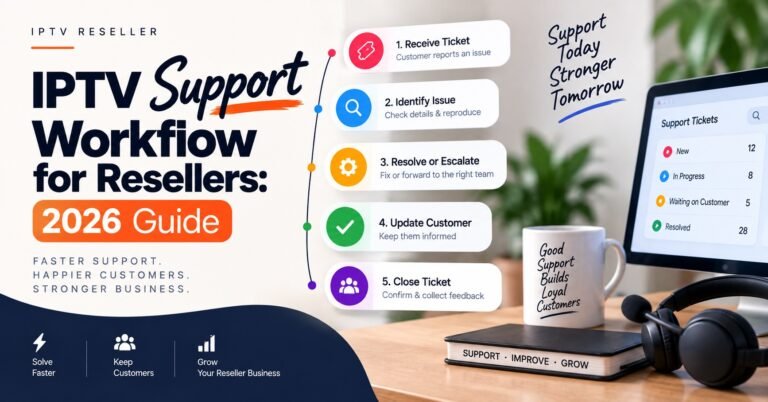
Tiered support delegation. You don’t need to hire staff. You need to create self-service resources. A knowledge base covering the ten most common issues — buffering fixes, VPN setup, EPG refresh, app installation guides — deflects the majority of first-contact support queries. Reserve your personal attention for escalated issues and reseller management.
Credit forecasting. At scale, running out of credits mid-week isn’t an inconvenience — it’s a revenue stoppage. Track your daily activation rate, calculate your average credit consumption per week, and maintain a minimum buffer of two weeks’ worth of credits at all times.
- Under 50 subscribers: weekly credit purchasing works fine
- 50–200 subscribers: maintain a rolling two-week credit buffer
- 200+ subscribers: negotiate bulk pricing directly with your provider and hold a 30-day reserve
The operators running a serious IPTV reseller business UK at scale aren’t doing dramatically different things than small resellers. They’re doing the same things with systems instead of manual effort.
Customer Churn Psychology: What Your Subscribers Won’t Tell You Before They Leave
Churn in the IPTV reseller business UK doesn’t announce itself. Subscribers don’t send you a thoughtful email explaining why they’re leaving. They simply don’t renew. And by the time you notice, they’ve already found an alternative.
Understanding why customers leave requires thinking about their experience during three critical moments:
The first 48 hours. If a new subscriber can’t get the service working on their device within the first evening, there’s a strong probability they’ll request a refund before day three. First-use experience determines whether you have a customer or a chargeback.
The first outage. Every IPTV service experiences downtime. What matters isn’t the outage itself — it’s whether you communicated proactively. A simple broadcast message saying “we’re aware of an issue, working on a fix, estimated resolution within the hour” converts a negative experience into proof that a human is managing the service.
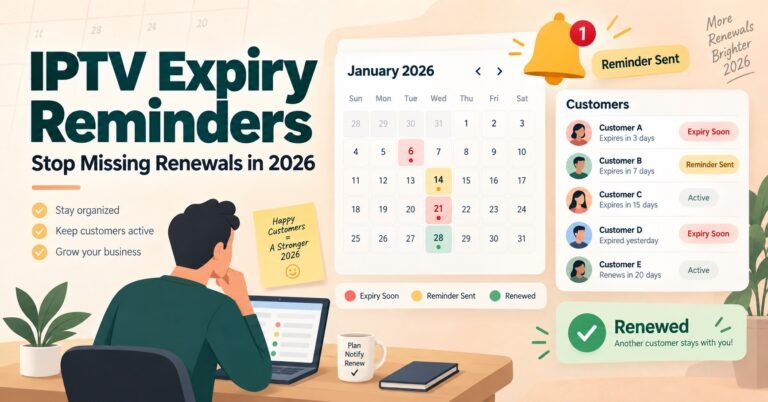
The renewal window. The 48 hours before a subscription expires is when competitors are most dangerous. If a subscriber has experienced even one unresolved issue during their billing period, they’re evaluating alternatives during that window. A renewal reminder paired with a brief “how’s everything working?” message costs you nothing and acts as a retention touchpoint.
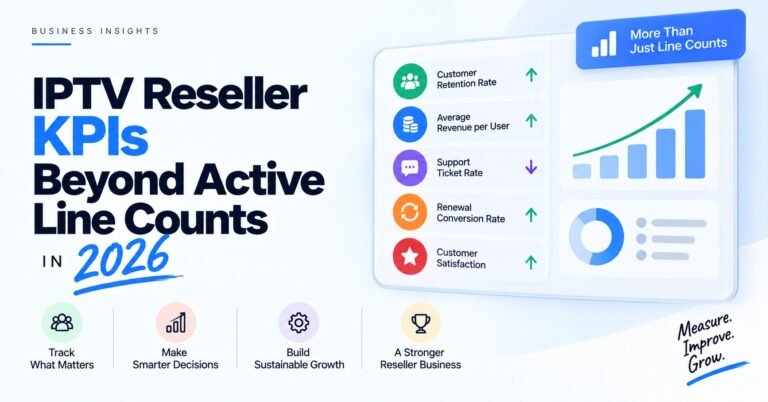
Pro Tip: Track your monthly churn rate as a percentage, not just a raw number. A 15% monthly churn rate means you’re replacing nearly your entire subscriber base every seven months. No amount of marketing fixes that.
The 2026 IPTV Reseller Business UK Entry Barrier Reality
Entering the IPTV reseller business UK market in 2026 is harder than at any point in the last decade. This isn’t speculation — it’s the cumulative result of enforcement escalation, market saturation, and customer sophistication.
Three years ago, you could start a reseller operation with zero technical knowledge, a WhatsApp group, and a basic panel. That model still technically functions, but its survival rate has collapsed. Customers now compare services on Reddit, Telegram groups, and review channels before committing. They know what HLS latency looks like. They know what load balancing failures feel like during peak hours. They know the difference between a reseller with infrastructure and one running on hope.
The new barrier isn’t financial — a viable start still costs under £500. The barrier is operational competence. You need to understand:
- How panel credit economics actually work across billing cycles
- Why DNS and VPN configuration is now a support requirement, not an edge case
- How to structure failover so a single provider outage doesn’t become a business-ending event
- When to absorb a chargeback versus when to fight it through your processor
If that list feels like work rather than excitement, this market may not be the right fit. The IPTV reseller business UK space in 2026 rewards operators, not opportunists.
Frequently Asked Questions
How much does it realistically cost to start an IPTV reseller business UK in 2026?
A functional start requires between £200 and £500, with the majority allocated to panel credits rather than branding or marketing. Your initial credit purchase is your inventory — without it, you have nothing to deliver. Domain and basic hosting can run under £30 for the first year, leaving maximum capital for the credits that actually generate revenue from day one.
What’s the biggest reason new IPTV resellers fail within three months?
Neglecting customer support is the primary cause. New operators focus entirely on subscriber acquisition while ignoring retention. When existing customers encounter issues and receive no response, they either churn silently or file chargebacks — both of which compound into unsustainable losses that no amount of new signups can offset.
Can I run an IPTV reseller business UK without any technical knowledge?
You can start without deep technical skills, but you cannot sustain without learning. At minimum, you’ll need to understand Xtream Codes or M3U line management, basic VPN configuration guidance for customers, DNS troubleshooting, and how your panel’s activation system works. These aren’t optional in 2026 — they’re daily operational requirements.
How do ISP blocks affect my subscribers and what should I do about it?
UK internet providers now use layered blocking including DNS filtering, deep packet inspection, and AI-driven traffic analysis. Your subscribers will experience streams failing without warning. The practical solution is ensuring every customer uses a VPN and providing clear setup instructions for each device type. Pre-configured apps reduce friction significantly.
Is it better to sell monthly or annual IPTV subscriptions?
Quarterly and annual plans generate more stable revenue and dramatically lower churn rates. Monthly subscribers evaluate alternatives every billing cycle, while longer commitments lock in cash flow and reduce your exposure to single-event dissatisfaction. Offer monthly as an option, but position multi-month plans as the recommended choice.
How many subscribers do I need before an IPTV reseller business UK becomes profitable?
Profitability depends on your margin per line, but most operators reach a meaningful income between 80 and 150 active subscribers. Below fifty, the revenue rarely covers time investment. The critical factor isn’t subscriber count alone — it’s churn rate. One hundred subscribers with 5% monthly churn is a business. One hundred subscribers with 20% churn is a treadmill.
What happens if my panel provider goes down during peak viewing hours?
Without a backup panel, you face a total service blackout for all subscribers — and the reputational damage during a high-profile event can cost you 40–60% of your base overnight. Maintaining a secondary panel with pre-loaded credits and tested credentials allows you to failover within minutes, keeping subscriber losses under 5%.
How do I handle chargebacks as an IPTV reseller in the UK?
Prevention is more effective than dispute resolution. Use clear billing descriptors so customers recognise charges. Send order confirmations with service details. Respond to refund requests promptly — absorbing a £6 refund is cheaper than fighting a £20 chargeback fee. For persistent disputes, maintain delivery logs showing subscription activation timestamps and usage data.
Your IPTV Reseller Business UK Execution Checklist
Start here. Not tomorrow. Today.
- Allocate 80%+ of your starting budget to panel credits — everything else is secondary until you can fulfill orders
- Set up a backup panel with a small credit balance and test it monthly — failover should take minutes, not hours
- Build a support template library covering buffering, VPN setup, EPG refresh, login issues, and app installation before your first subscriber arrives
- Create a VPN setup guide for every device type your customers use — Firestick, Android box, Smart TV, mobile
- Structure your default pricing around quarterly plans — monthly is the option, not the recommendation
- Track churn rate as a weekly percentage, not a monthly afterthought
- Automate activations through your panel’s API the moment you pass thirty active subscribers
- Maintain a rolling two-week credit buffer at all times — running dry mid-week is a revenue emergency
- Send proactive status updates during any service disruption — silence costs more than honesty
- Visit britishreseller.com to explore panel credit structures and reseller infrastructure built for UK operators who take this seriously
This is your operation. Run it like one.