
IPTV Reseller Panel: What Nobody Tells You Before You Buy Credits
Somewhere right now, a new reseller is loading up their first batch of panel credits, convinced that cheap pricing alone will carry them to profit. Within sixty days, half of them will have churned out of the business entirely. The ones who survive won’t be the ones who found the cheapest IPTV reseller panel — they’ll be the ones who understood what’s actually happening behind the dashboard.
This isn’t a tutorial. It’s a dissection of how an UK IPTV reseller panel really works in 2026, what’s changed since enforcement ramped up, and where the actual money leaks hide. If you’ve been reselling for a while and things feel harder than they used to, you’re not imagining it. The landscape shifted. Your panel setup needs to shift with it.
Let’s get into the mechanics that separate a reseller who lasts from one who quietly disappears.
What an IPTV Reseller Panel Actually Does Under the Hood
Most newcomers treat an IPTV reseller panel like a storefront. Add credits, generate lines, hand them to customers, collect payment. That’s the surface. Underneath, your panel is communicating with backend middleware — usually Xtream Codes or an XUI fork — handling authentication tokens, playlist generation, EPG injection, and connection routing in real time.
Every time a subscriber hits play, the panel validates their credentials, assigns a server connection, and begins streaming over HLS or MPEG-TS. If you don’t understand that chain, you can’t diagnose problems when they inevitably appear. And they will appear.
Pro Tip: Before committing to any IPTV reseller panel provider, ask specifically how many concurrent connections their backend cluster handles before load balancing kicks in. If they can’t answer that question with a number, walk away.
The Credit Economy Nobody Explains Properly
Panel credits are the currency of the IPTV reseller panel ecosystem, but the pricing model is designed to obscure margin. Here’s what actually happens: your provider buys server capacity and content feeds in bulk, then packages access into credits sold to you at a markup. You then mark up again when selling to end users.
The trap? Buying credits in small quantities destroys your margin before you’ve even started. A reseller purchasing 10 credits at a time might pay £5 per credit. Someone buying 100 at once might pay £2.50. That gap is the difference between a profitable operation and one that’s bleeding out slowly.
What a healthy credit strategy looks like:
- Start with a mid-tier bulk purchase (50–100 credits) to test panel reliability before scaling
- Track your actual activation-to-renewal ratio — not every credit you activate will renew
- Hold a reserve of at least 15% unactivated credits for rapid customer onboarding
- Never buy from a provider whose credit pricing changes month to month without explanation
The IPTV reseller panel providers who offer wildly cheap credits are almost always cutting corners on infrastructure. That cost saving gets passed to your subscribers as buffering.
Why Load Balancing Decides Who Survives Match Nights
Saturday evening. Major sporting event. Every subscriber on your IPTV reseller panel tries to connect within the same fifteen-minute window. This is where infrastructure either holds or collapses, and it’s the single biggest reason resellers lose customers permanently.
Load balancing distributes incoming connections across multiple server nodes so no single machine gets crushed. The problem is that many mid-tier panel providers run what looks like load balancing but is actually round-robin DNS — a basic rotation that doesn’t account for real-time server load. The result: half your subscribers get a smooth stream, the other half get buffering loops and frozen frames.
| Factor | Budget Infrastructure | Professional Infrastructure |
|---|---|---|
| Load Distribution | Round-robin DNS | Real-time weighted balancing |
| Failover Speed | 30–120 seconds | Under 5 seconds |
| Peak Concurrent Users | 500–1,000 | 5,000–20,000+ |
| CDN Integration | None | Multi-node edge caching |
| Uplink Redundancy | Single source | 2–3 backup uplinks |
If your IPTV reseller panel provider can’t tell you their failover time, assume it’s the slow kind. Your customers won’t wait two minutes staring at a loading wheel. They’ll message you, then they’ll leave.
The ISP Blocking Problem That Changed Everything in 2026
Here’s something that barely gets discussed in reseller communities: ISP-level blocking has become significantly more sophisticated. It’s no longer just DNS poisoning, where your provider’s domain gets blacklisted at the resolver level. We’re now dealing with deep packet inspection that identifies IPTV streaming patterns regardless of the domain or IP being used.
What does this mean for anyone running an IPTV reseller panel? It means your subscribers in certain regions will intermittently lose access even though your panel shows their line as active. The line works. The server works. The ISP is silently throttling or dropping the connection.
Pro Tip: Advise every subscriber to use a reputable VPN as standard practice — not as a troubleshooting step, but as default setup. The days of IPTV working flawlessly on a raw connection are mostly finished in the UK and parts of Western Europe.
The resellers who preempt this conversation — who include VPN guidance in their onboarding — get dramatically fewer support tickets. The ones who wait until customers complain spend their evenings explaining DNS settings over WhatsApp.
Panel Management: Where Resellers Waste the Most Time
Managing an IPTV reseller panel is roughly 30% sales and 70% operations. New resellers assume the opposite and burn out when they realise how much time goes into line management, subscription renewals, customer troubleshooting, and monitoring server status.
The biggest time sink? Expired lines. When a subscription lapses and the customer doesn’t renew immediately, that line sits in limbo. Some panels auto-delete after a set period. Others keep the line indefinitely, cluttering your dashboard. Neither approach is ideal without a system around it.
A tighter workflow looks like this:
- Set renewal reminders 3 days before expiry — automated if your panel supports it, manual if not
- Purge genuinely dead lines every 30 days to keep your dashboard clean
- Tag high-value customers (multi-connection households, long-term renewals) so they get priority attention
- Log every technical complaint with the resolution — patterns will emerge that point to infrastructure issues, not user error
Your IPTV reseller panel is a business tool, not a vending machine. The resellers who treat it like an operations hub outperform those who treat it as passive income.
Customer Churn Is a Panel Problem, Not a Marketing Problem
The instinct when customers leave is to blame pricing. “Someone undercut me.” That’s true sometimes. But in most cases, churn from an IPTV reseller panel traces back to three operational failures: inconsistent stream quality, slow support response, and confusing setup instructions.
Stream quality is infrastructure — you control it by choosing a panel provider with proper backend capacity. Support response is process — you control it by being available and responsive during peak hours. Setup instructions are documentation — you control it by creating clear guides for every device your subscribers use.
Pro Tip: Create a single-page PDF setup guide for Firestick, Smart TV, and mobile. Send it automatically when you activate a line. This alone cuts initial support requests by 40% or more.
Subscribers who have a smooth first 48 hours with your IPTV reseller panel almost always renew. The ones who spend their first evening troubleshooting almost never do. First impressions aren’t a cliché — they’re the economics of retention.
Scaling Beyond 100 Subscribers Without Losing Control
There’s a ceiling most IPTV reseller panel operators hit somewhere between 80 and 150 active subscribers. Below that number, you can manage everything manually — WhatsApp messages, mental notes, checking the panel once or twice a day. Above it, things start falling through cracks. Renewals get missed. Support responses slow down. New activations pile up during peak hours.
Scaling past this point requires three things:
- A structured tracking system outside your panel — even a basic spreadsheet logging subscriber name, activation date, expiry, device type, and complaint history
- Defined support windows — you cannot be available 24/7 and shouldn’t pretend to be; set clear hours and communicate them
- Sub-reseller recruitment — this is where real growth happens; recruiting your own resellers under your IPTV reseller panel creates leverage without linear effort
The sub-reseller model works because it converts your best customers into distribution partners. They handle end-user support for their own subscribers while you manage panel credit allocation and backend reliability.
Backup Uplink Servers: The Insurance Policy Nobody Buys
When your primary content uplink goes down, every subscriber on your IPTV reseller panel loses service simultaneously. It doesn’t matter how good your load balancing is, how clean your panel dashboard is, or how loyal your customers are. If the feed source drops, everything stops.
Backup uplink servers are the solution, and almost nobody at the reseller level asks about them. You should be demanding that your panel provider operates at least two independent uplink sources. If one feed drops — due to enforcement action, hardware failure, or upstream provider issues — the system should automatically switch to the secondary source with minimal interruption.
| Uplink Setup | Downtime During Outage | Customer Impact |
|---|---|---|
| Single uplink, no backup | Full outage until restored | Mass complaints, refund requests, churn |
| Dual uplink, manual switch | 10–30 minutes | Moderate complaints, some churn |
| Dual uplink, automatic failover | Under 60 seconds | Most subscribers won’t notice |
Ask your provider directly: “What happens when your primary uplink goes down?” The answer tells you everything about whether they’ve built a serious operation or a fragile one. Your IPTV reseller panel is only as reliable as the weakest link behind it.
EPG and VOD: The Details That Signal Professionalism
Electronic Programme Guide data and Video on Demand libraries seem like small details compared to live stream reliability. They’re not. For households — especially families with multiple viewers — a well-maintained EPG and a current VOD library are the difference between “this feels like a real service” and “this feels like a dodgy stream.”
Your IPTV reseller panel provider should be refreshing EPG data at minimum every 12 hours. Stale EPG — where the guide shows yesterday’s programming — is one of the most common complaints from family subscribers. It doesn’t affect stream quality, but it affects perception, and perception drives renewals.
Pro Tip: Before activating a new customer, spend two minutes checking that their channel category has current EPG data. A broken guide on day one makes you look amateur, regardless of how stable the actual streams are.
VOD libraries matter for a different reason: they reduce peak-time load. When subscribers browse and watch on-demand content during off-peak hours, they’re not all hammering live channels during sporting events. A good VOD catalogue within your IPTV reseller panel indirectly improves live stream performance for everyone.
Pricing Your Lines Without Racing to the Bottom
There’s a persistent myth in the IPTV reseller panel space that the cheapest price wins. It doesn’t. The cheapest price attracts the most demanding, least loyal customers — the ones who will leave the moment someone offers 50p less per month. Meanwhile, you’ve destroyed your margin chasing volume you can’t profitably serve.
A better approach is tiered packaging. Structure your IPTV reseller panel offerings into two or three tiers based on connection count and content access. A single-connection package for individual viewers. A household package with two or three connections. A premium tier with additional VOD access or priority support.
Pricing psychology that actually works:
- Anchor your mid-tier as the “recommended” option — most buyers will choose it
- Price the single-connection tier close enough to the household tier that upgrading feels obvious
- Never discount for first-time buyers — it sets an expectation you can’t sustain
- Offer a small loyalty discount at renewal instead, rewarding retention over acquisition
The resellers making real money from their IPTV reseller panel are charging fair prices and delivering consistent quality. The ones racing to the bottom are subsidising their subscribers’ entertainment at their own expense.
Risk Mitigation: What Operators Who Last Do Differently
Running an IPTV reseller panel in 2026 carries more operational risk than it did three years ago. Enforcement actions are faster. Payment processors are more cautious about the sector. Domain takedowns happen with less warning.
The operators who endure don’t just hope things stay stable — they build contingency into every layer.
Domain strategy matters. Running your storefront on a single domain with no backup means a takedown wipes out your online presence overnight. Maintain at least one alternate domain, configured and ready to switch.
Payment diversification matters. Relying on a single payment method — especially one tied to a processor that might suddenly flag your account — creates a single point of failure. Cryptocurrency, bank transfers, and multiple gateway options spread that risk.
Communication channels matter. If your only customer contact method is a WhatsApp number linked to one phone, losing that number means losing your entire subscriber base’s contact path. Maintain a Telegram backup channel or email list at minimum.
Pro Tip: Keep an offline record of your top 50 subscribers’ contact details and subscription dates. If your IPTV reseller panel goes down hard and you need to migrate to a new provider, that list is the difference between rebuilding and starting over.
Frequently Asked Questions
What exactly is an IPTV reseller panel and how does it work?
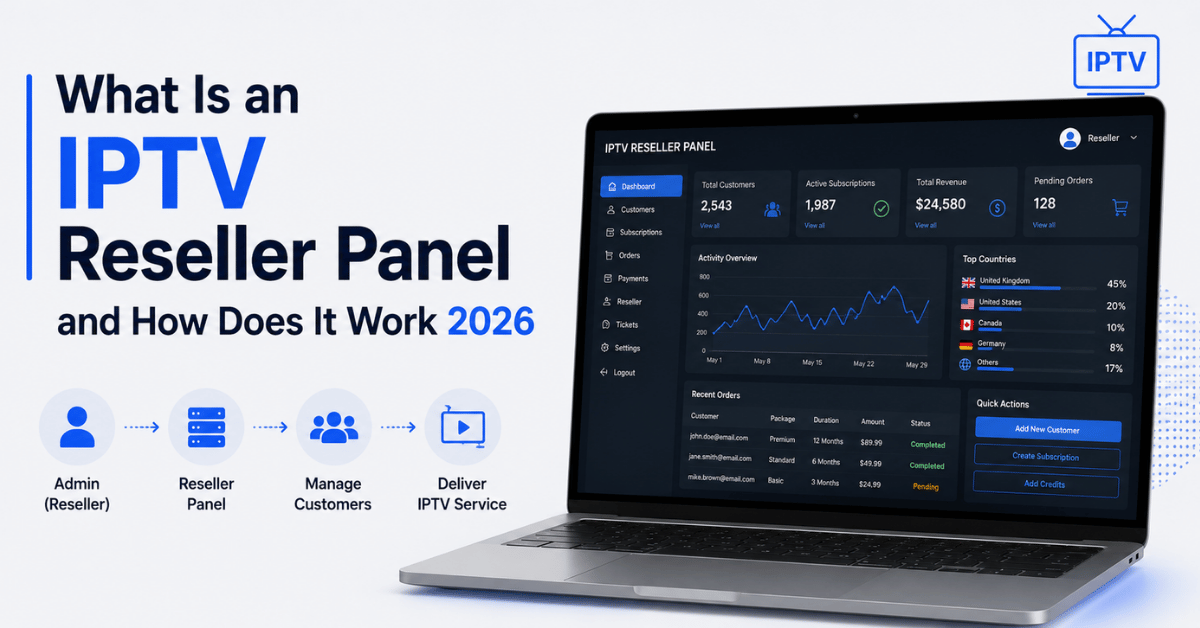
An IPTV reseller panel is a web-based dashboard that lets you create, manage, and distribute IPTV subscription lines to end users. You purchase credits from a provider, activate lines for subscribers, and manage renewals, all through a centralised interface connected to backend streaming servers. It functions as your entire business operations hub.
How many credits should I buy when starting with an IPTV reseller panel?
Start with 50 to 100 credits to balance cost efficiency against risk. Buying fewer than 50 means higher per-credit pricing that squeezes your margins. Going above 100 before you’ve tested reliability for at least 30 days risks locking money into a provider who might underperform during peak demand periods.
Can I run an IPTV reseller panel from Pakistan or outside the UK?
Yes, the panel itself is cloud-based and accessible from anywhere with an internet connection. Your subscriber base can be global. However, payment processing, domain jurisdiction, and local regulations vary by country, so research your specific obligations. Many successful operators run panels serving UK audiences from overseas locations.
Why do my subscribers experience buffering even though the panel shows active lines?
Buffering is almost always an infrastructure or network issue, not a panel issue. Common causes include overloaded backend servers during peak hours, ISP-level throttling of streaming traffic, insufficient CDN coverage in the subscriber’s region, or the subscriber’s own connection being too slow. A VPN often resolves ISP throttling.
How do I handle ISP blocking affecting my IPTV reseller panel subscribers?
Proactively include VPN setup instructions in your subscriber onboarding materials. DNS poisoning and deep packet inspection are increasingly common, particularly in the UK and EU. Subscribers using a quality VPN bypass most ISP-level interference. Don’t wait for complaints — make VPN usage part of your standard activation process.
Is it worth recruiting sub-resellers under my IPTV reseller panel?
Absolutely, once you’ve stabilised your own subscriber base above 80 to 100 lines. Sub-resellers multiply your distribution without multiplying your workload proportionally. You allocate credits to them at a markup, they handle their own end-user support, and your role shifts from retail operator to wholesale distributor. It’s the most scalable growth model available.
What should I look for when choosing an IPTV reseller panel provider?
Prioritise automatic load balancing, backup uplink servers, current EPG data, responsive provider support, and transparent credit pricing. Ask about failover time, concurrent connection limits, and what happens during outages. Avoid providers who can’t answer technical questions about their infrastructure — it means they’re reselling someone else’s setup without understanding it.
How often should I refresh or audit my IPTV reseller panel setup?
Conduct a full audit monthly. Check expired lines, review subscriber complaint patterns, verify EPG freshness, test stream quality on multiple devices, and compare your credit costs against current market rates. Quarterly, reassess your panel provider entirely. The IPTV landscape shifts fast, and loyalty to an underperforming provider costs you subscribers.
IPTV Reseller Panel Success Checklist
- Audit your current panel provider’s infrastructure — confirm load balancing type, failover time, and uplink redundancy before your next credit purchase.
- Build a subscriber tracking spreadsheet outside your panel with name, device, expiry date, and complaint history columns.
- Create device-specific setup guides for Firestick, Smart TV, and mobile — send automatically with every new activation.
- Include VPN configuration instructions as part of standard onboarding, not as a troubleshooting afterthought.
- Set up automated or manual renewal reminders three days before each subscription expires.
- Purge dead and expired lines from your IPTV reseller panel dashboard every 30 days.
- Structure pricing into at least two tiers — single connection and household — with the household tier positioned as the obvious value choice.
- Maintain a backup domain, configured and ready to deploy, in case your primary storefront faces takedown.
- Diversify payment methods across at minimum two channels to avoid single-processor dependency.
- Explore sub-reseller recruitment once your active base passes 80 lines — visit britishseller.co.uk to source reliable IPTV reseller panel credits with competitive bulk pricing and proven backend stability.